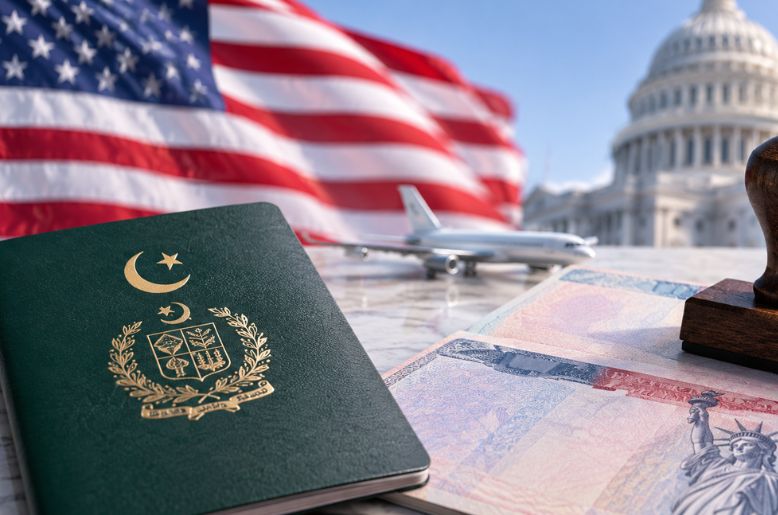
The United States has officially made its visa bond program permanent, introducing stricter rules for selected visitor visa applicants from 50 countries. The move has raised questions among Pakistani travellers, but Pakistan is not among the countries currently covered by the programme.
The new rules, which took effect in early August, apply only to selected applicants seeking B-1 business and B-2 tourist visas from designated countries. Under the policy, US consular officers may require applicants to deposit a refundable bond ranging from $10,000 to $20,000 before a visa is issued.
The visa bond program replaces a 12 month pilot launched in 2025 after US authorities concluded it had significantly reduced visa overstays. According to the US State Department, fewer than 50 overstays were recorded during the first 10 months of the pilot, compared with more than 45,000 overstays from the same group of countries in 2024.
Officials said the programme also led to an 83 percent decline in visa issuance among participating countries, suggesting that some applicants chose not to proceed rather than pay the required bond.
For Pakistani applicants, however, there is no immediate change. Pakistan has not been included in the list of 50 countries subject to the visa bond program, a position also confirmed by diplomatic sources.
Among South Asian nations, Bangladesh, Bhutan and Nepal are included, while India and Pakistan are not. Afghanistan and Iran are also excluded because the United States does not maintain normal diplomatic relations with those countries.
The bond requirement is not automatic even for countries covered by the programme. Instead, US consular officers will decide on a case by case basis whether an applicant should be asked to provide a bond.
The amount can be set at $10,000, $15,000 or $20,000, with $15,000 expected to be the standard in most cases. The bond may be paid by the applicant or another person and is refunded if the visitor follows all visa conditions and leaves the United States before the authorised stay expires. Those who overstay or violate visa terms risk losing the deposit.
The State Department said the list of countries covered by the visa bond program may be updated over time, with any new designations announced at least 15 days before they take effect. The programme applies only to B-1 and B-2 visitor visas and does not affect other US visa categories.