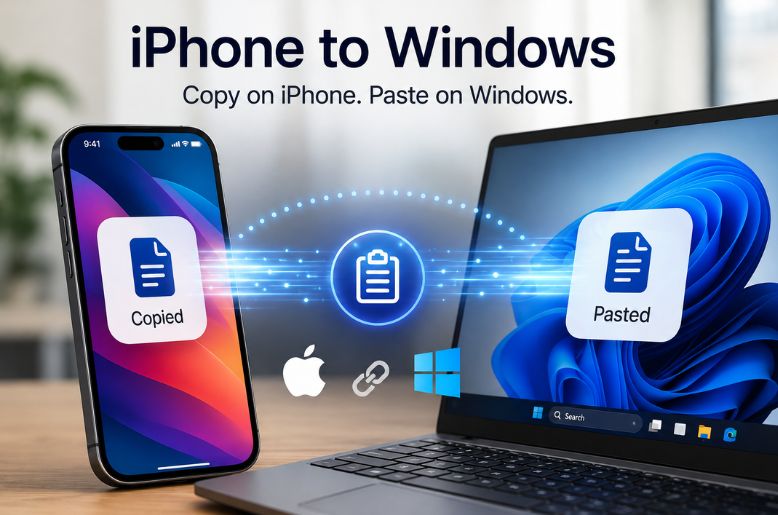
Apple is working on a feature that could make life much easier for people who use both an iPhone and a Windows PC. If it arrives as planned, users will be able to copy text, links, images and other supported content on one device and instantly paste it on the other without relying on extra apps or awkward workarounds.
The project came after Microsoft asked Apple to support cross device clipboard syncing through the company’s European Union interoperability programme, which Apple introduced to comply with the Digital Markets Act. Apple started reviewing the request in March and shared a proposed development plan in late June.
The goal is simple. Copy something on an iPhone, switch to a Windows PC and paste it straight away. The same would work in reverse, creating a smoother experience for people who regularly move between Apple’s smartphones and Microsoft’s computers.
Unlike today’s methods, the feature is designed to run quietly in the background after a one time setup. Users would not need to keep opening apps or repeatedly approve every clipboard transfer.
Apple’s proposal would require users to give one time permission for each paired Windows PC before clipboard sharing is enabled. The company plans to build the feature using technology similar to the system it introduced for third party accessories in the European Union with iOS 26.5.
At present, apps on the iPhone can only access clipboard data while they are open on screen, and users must approve clipboard access during copy and paste actions. Apple already offers its own Universal Clipboard feature, but it only works between Apple devices such as iPhones, iPads and Macs.
Microsoft has argued that these restrictions make continuous clipboard syncing with Windows impossible, preventing the seamless experience users expect.
Apple says building the new system will require significant engineering work. The company expects development to finish by autumn 2027, with the feature first appearing in a developer beta before a wider public rollout. That means most users are unlikely to get access until early 2028.
For now, the feature is expected to be available only in the European Union because it stems from DMA rules. However, Apple has expanded some EU driven features globally in the past, leaving the door open for a wider release in the future.
Read next: Apple could be planning its most futuristic iPhone for 2028