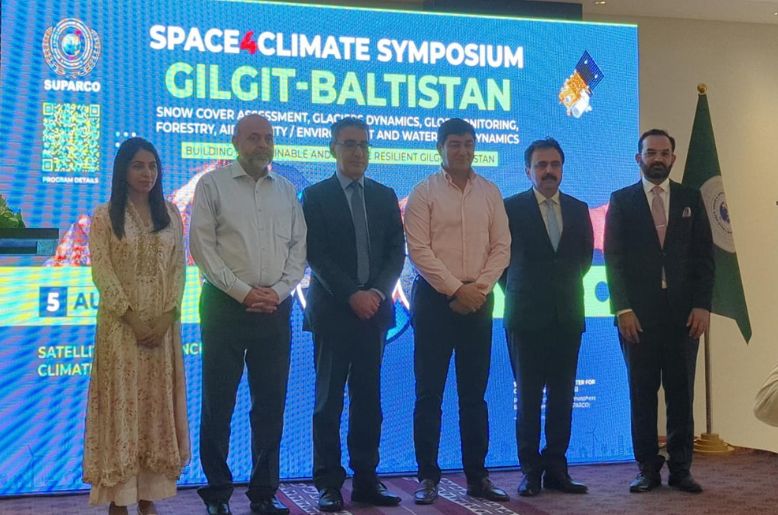
The Pakistan Space & Upper Atmosphere Research Commission (SUPARCO), through its Space Applications Centre for Climate Sciences (SACCS), successfully hosted the Second Regional Symposium on the theme “Space4Climate – Snow Cover Assessment, Glacier Dynamics, GLOF Monitoring, Forestry, Air Quality/Environment and Waterways Dynamics”, at Ramada Hotel, Gilgit.
The symposium marked the second successful event in SUPARCO’s seven-city National and Provincial Symposium Series under the Space4Climate Initiative and Awareness on Climate Change Impacts, which will be held in Islamabad, Lahore, Karachi, Peshawar, Quetta, Gilgit and Muzaffarabad. The first symposium was kicked off in Peshawar on 23 July 2026.
The symposium brought together senior government officials, policymakers, scientists, researchers, development partners, academia, and environmental experts to strengthen collaboration on the application of space technologies for climate resilience and sustainable development.
The symposium served as a strategic platform to showcase Pakistan’s indigenous space-based capabilities for climate monitoring and to promote evidence-based policymaking through satellite-derived climate intelligence. Participants discussed emerging climate risks facing Gilgit-Baltistan and the country.
These included glacier retreat and surging, glacial lake outburst floods (GLOFs), disasters, deteriorating air quality, and changing water resources, while highlighting the critical role of Earth observation technologies in addressing these challenges.
The inaugural session featured welcome remarks by Dr Amjad Ali, Director General, Space Applications and Research Centre, SUPARCO. The symposium was graced by Mr Raja Nasir Ali Khan, Minister for Forest, Wildlife, Parks and Environment, Government of Gilgit-Baltistan, as the Chief Guest and emphasised the importance of integrating advanced geospatial technologies into climate governance and disaster risk reduction.
In his keynote address, Mr Raja Nasir Ali Khan commended SUPARCO for launching the Space4Climate Initiative and appreciated its efforts to harness indigenous space technologies in support of climate resilience and sustainable development.
He expressed particular interest in the Space4Climate Geospatial Portals and acknowledged their potential to strengthen evidence-based decision-making and environmental governance.
The Minister highlighted the Government of Gilgit-Baltistan’s recent establishment of the Glacier Protection Authority as a significant institutional step towards safeguarding the region’s fragile cryosphere.
He further shared that the Government is considering the establishment of a Centre of Excellence on Glaciers to promote scientific research, innovation, capacity building, and collaborative solutions for glacier monitoring and climate adaptation.
He also called for collaboration on both initiatives with the GB Government. Furthermore, emphasising that tourism and climate change are two of the region’s foremost priorities, the Minister stressed the need to strike a balance between sustainable tourism development and the conservation of fragile mountain ecosystems.
He underscored that addressing climate challenges requires practical action rather than dialogue alone, and called for stronger partnerships among federal and provincial institutions, scientific organisations, academia, and development partners.
He reaffirmed the Government of Gilgit-Baltistan’s commitment to fostering joint initiatives, expanding the use of geospatial technologies, and supporting collaborative efforts that enhance disaster preparedness, environmental protection, and long-term climate resilience across the region.
Remarks were also delivered by Mr Sibtain Ahmed, Secretary, Forest Wildlife & Environment Department, Government of Gilgit-Baltistan, who underscored the need for stronger institutional collaboration and the use of scientific data to support climate adaptation, environmental protection, and national resilience.
Mr Sibtain Ahmed shared his professional experiences in addressing the region’s environmental and climate-related challenges.
He emphasised that the complex issues facing Gilgit-Baltistan, including glacier change, water resource management, ecosystem conservation, and disaster risks, can be more effectively addressed through the application of space-based technologies and geospatial intelligence.
Appreciating SUPARCO’s regional outreach under the Space4Climate Initiative, he expressed his full support for strengthening collaboration among government departments, scientific institutions, academia, and development partners.
He also reaffirmed the Department’s willingness to work closely with SUPARCO, particularly its regional centre, to advance the operational use of satellite-based information for climate adaptation, environmental management, and evidence-based decision-making in Gilgit-Baltistan.
A major highlight of the symposium was the presentation of SUPARCO’s Space4Climate initiative and a live demonstration of the Space4Climate Geospatial Portals, showcasing how satellite-based climate intelligence can support informed decision-making across national and provincial institutions.
The portal integrates data from Pakistan’s satellite assets, including PRSS-1, SAR-1, EO series and hyperspectral capabilities, to provide near real-time information on greenhouse gases, air quality, glaciers, snow cover, waterways, land cover, coastal ecosystems, and other critical environmental indicators.
The technical session featured presentations by experts covering key thematic areas, including climate vulnerability assessment for Gilgit-Baltistan, glacier monitoring and mapping using optical and Synthetic Aperture Radar (SAR) satellite data, forest cover change detection, GLOF monitoring, and satellite-based air quality and environmental assessment.
The presentations demonstrated the growing role of indigenous space technologies in delivering operational solutions for climate adaptation, disaster risk reduction, and sustainable resource management.
An interactive panel discussion on “Institutionalising Space-Based Climate Services for Climate Governance” highlighted the importance of strengthening inter-agency coordination, expanding access to geospatial information, and mainstreaming satellite-derived climate services into planning, disaster preparedness, natural resource management, and environmental governance.
The symposium concluded with recommendations emphasising the institutional adoption of Space4Climate services across government departments, strengthened collaboration among scientific and government organisations, enhanced capacity building in geospatial technologies, and continued development of operational climate information services to support evidence-based policymaking.
The Regional Symposium reflects SUPARCO’s continued commitment to harnessing space science and technology for peaceful applications that contribute to national development, climate resilience, environmental sustainability, and Pakistan’s commitments under the Sustainable Development Goals (SDGs), the Paris Agreement, and the Sendai Framework for Disaster Risk Reduction.
