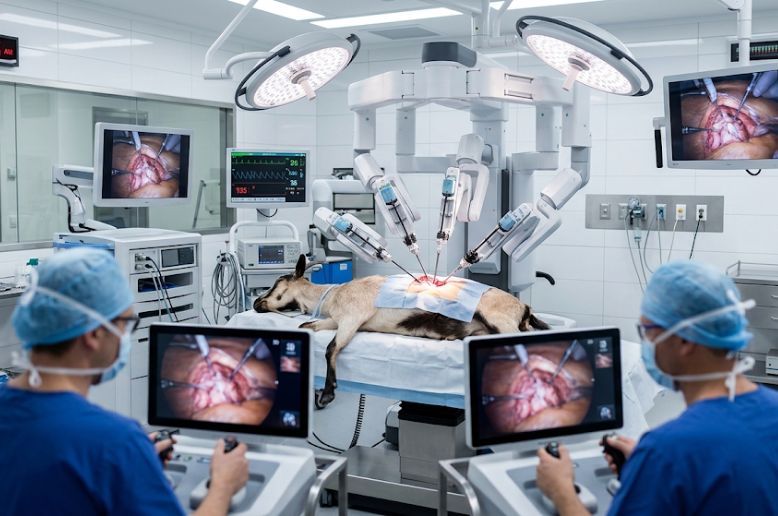
An important development has emerged in the field of surgery, where researchers from the University of California, San Diego, in the United States, have successfully completed a complex operation on an animal for the first time with the help of two robots.
According to the research, the robots successfully removed the animal’s damaged spleen from its body. The special aspect of this experiment was that most of the operation was performed by the robots themselves, while doctors located at a distance provided monitoring and guidance through remote control.
According to the researchers, this experiment is an important step toward the possibility that, in the future, robot surgeons equipped with artificial intelligence will be able to perform complex medical operations with greater autonomy.
The robots completed the operation themselves
The robots involved in the research were used to perform different stages of the operation. The robots completed the process of identifying the damaged spleen, separating it from other parts of the body, and successfully removing it.
Although doctors were monitoring the entire process and remotely controlling the robots when necessary, the basic stages of the operation were performed by the robots themselves.
The researchers say that this achievement could prove to be an important milestone in the development of autonomous robotic surgery.
Read more: OpenAI launches ChatGPT 5.5, taking on competitors Google and Anthropic
American researchers now want to advance this technology toward its use in medical operations on humans. However, before it can be used on humans, further experiments will be required to test the safety, accuracy, and reliable performance of the technology.
According to experts, the successful operation on an animal does not mean that robot surgeons will immediately begin performing autonomous operations on humans; rather, several stages will have to be passed through for this.
Artificial intelligence could change the future of surgery
Experts involved in the research have predicted that in the coming years, robot surgeons could gain greater autonomy through artificial intelligence and become capable of performing various stages of complex operations themselves.
If this technology develops further, the roles of human doctors and artificial-intelligence-powered robots could significantly change in the field of surgery in the future.
However, according to experts, several important questions, including medical safety, ethical principles, and legal responsibilities, will need to be resolved before complete autonomy can be used in operations involving human lives.
This research has been published in the renowned scientific journal Nature, and it is being described as an important development in the fields of robotic surgery and artificial intelligence.
Also read: Send AI-generated stickers to your WhatsApp contacts using ChatGPT