
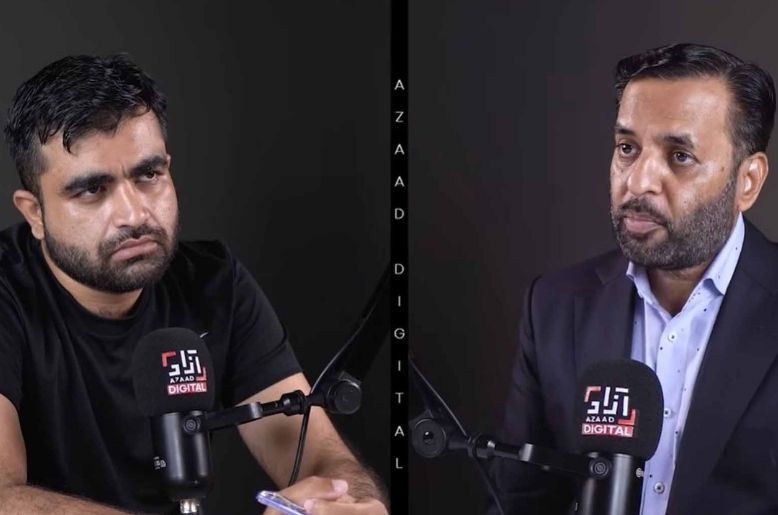
Federal Health Minister Mustafa Kamal has strongly supported the creation of new administrative units and provinces, saying Pakistan’s existing four-province structure can no longer meet the needs of its growing population.
In an exclusive interview with Azaad Digital, Kamal discussed Karachi’s development, the local government system, the creation of new administrative units and provinces, the Pakistan Peoples Party’s position, constitutional amendments, Sindh’s financial resources, medicine prices and his tenure as Karachi’s mayor.
Kamal said Pakistan had a population of around 37 million when it was established and had four provinces. The country’s population has now crossed 260 million, yet the administrative structure remains largely unchanged.
He said Punjab, Sindh, Khyber Pakhtunkhwa and Balochistan are each larger than many countries in terms of area, making the creation of new administrative units necessary to improve governance and bring government services closer to the people.
Cites India and other countries
Kamal cited India and several other countries as examples, saying they created new provinces and administrative units as their populations and administrative needs increased.
He said India had nine provinces at the time of independence, while the number has now increased to 38. He added that Turkey, Iran, Afghanistan, the United States and other countries also have multiple administrative units based on their population and governance needs.
According to Kamal, the purpose of creating new administrative units is not to erase the identity of any region but to establish a more effective system of governance closer to the people.
‘PPP should question Bhutto’s position’
Kamal criticised Pakistan Peoples Party leaders for presenting the demand for new administrative units as unconstitutional or unacceptable.
He said PPP leaders should question their own founder, Zulfikar Ali Bhutto, rather than those calling for new provinces, as the 1973 Constitution already provides a procedure for creating new provinces.
“The Constitution is not a book that cannot be changed according to changing circumstances,” Kamal said, adding that the Constitution has already undergone several amendments over the decades.
He argued that if an existing system fails to meet the needs of changing times, it can be amended.
‘Administrative division does not mean division of Sindh’
Rejecting the argument that new administrative units would amount to dividing Sindh, Kamal said administrative boundaries and historical or cultural identities were two separate matters.
He cited Karachi as an example, saying the city had been divided from one district into seven for administrative purposes without affecting either Karachi’s existence or Sindh’s identity.
He compared the process to expanding a house, saying that just as people add rooms or floors when a house becomes larger, new administrative units can be created as the population grows.
Kamal questions use of Sindh’s funds
Kamal also criticised the Sindh government, claiming that the province had received around Rs22 trillion over the past 18 years but continued to face a serious shortage of basic services in both urban and rural areas.
Referring to conditions in parts of interior Sindh, he said some women were forced to use extremely poor-quality water for drinking, while the health and education systems also faced serious problems.
He questioned the existing governance and administrative system, saying that the availability of such large financial resources should have resulted in better basic services for the people.
Recalls his tenure as Karachi mayor
Kamal also spoke about his tenure as Karachi’s mayor, saying around Rs300 billion was spent during his term with a focus on transparency and accountability.
He said his approach was based on avoiding corruption, maintaining honest intentions and carrying out practical work at the grassroots level.
According to Kamal, this approach helped Karachi become one of the 12 fastest-growing cities in the world at the time.
He contrasted that period with Karachi’s current situation, saying the city is now facing severe problems despite having access to significant financial resources.
