
A shocking white paper presented by Ikhtiar Wali has raised serious questions over the Khyber Pakhtunkhwa government’s performance, highlighting alleged governance failures and concerns over smuggling, narcotics and terrorism across the province.
A shocking surge in violence has raised serious questions over KP Chief Minister Sohail Afridi’s security policy, as police casualties and terrorist attacks continue to climb.
Police personnel killed in the first half of 2026 surged 93.7% compared with H1 2025, nearly doubling the death toll. Police injuries also jumped 108.3%, more than doubling over the same period.
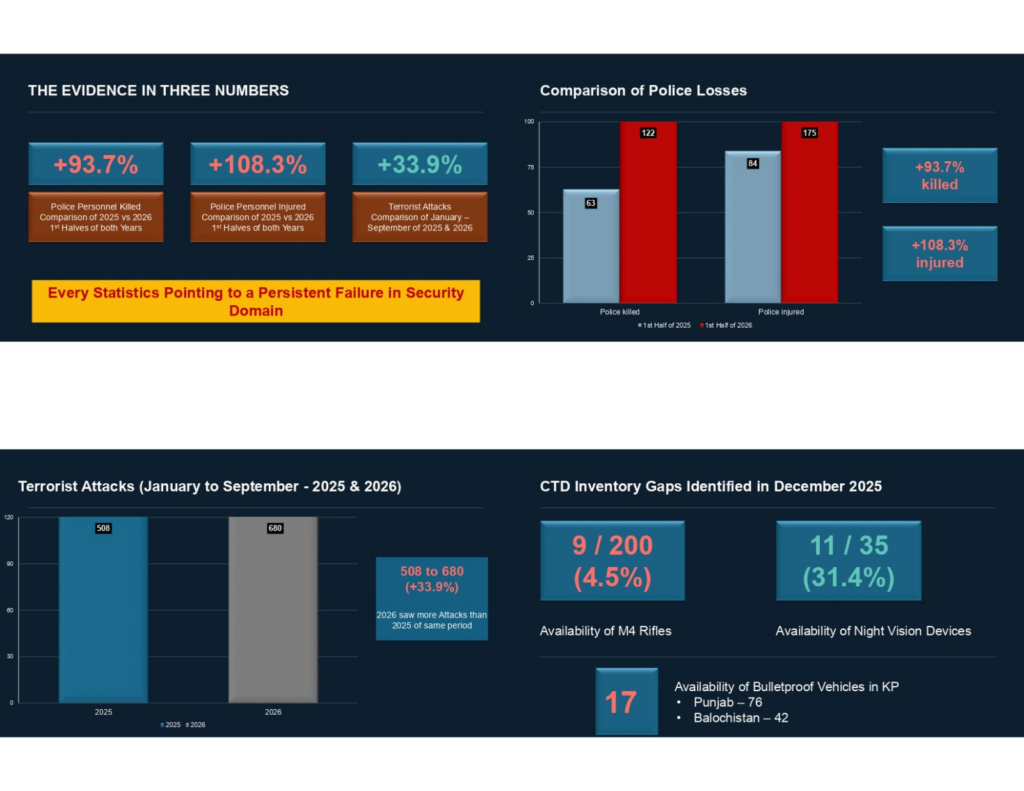
Meanwhile, terrorist attacks across KP increased by 33.9% from January to September 2026 compared with the corresponding period last year, intensifying scrutiny of the provincial government’s handling of the worsening security situation.
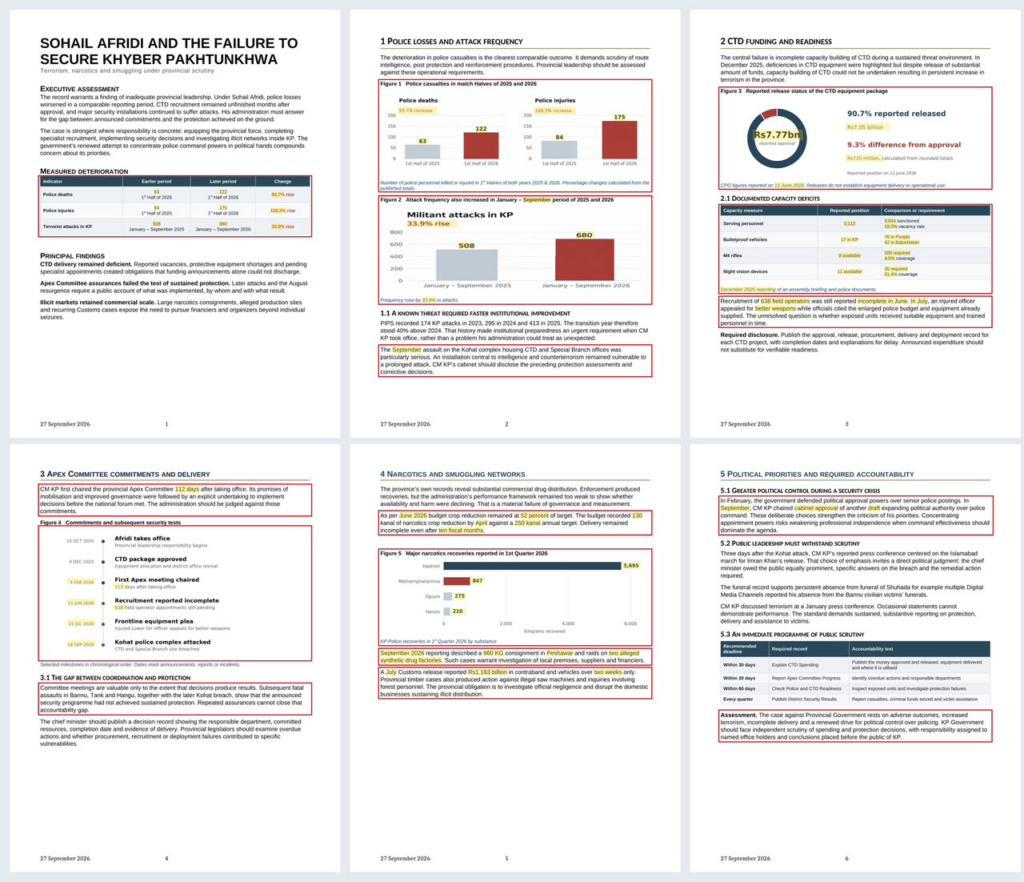
The white paper states that Rising attacks and police casualties have raised serious questions over the provincial government’s security strategy and institutional preparedness.
Attack on CTD and Special Branch offices in Kohat in September 2026; protection of a key counter-terrorism centre has also become a question.
Rs7.77 billion approved for CTD equipment; Rs7.05 billion released by June 2026, leaving a difference of Rs720 million.
Release of funds is one thing, but where are the details of equipment provision and practical use? Questions demanding answers over CTD preparedness.
A December 2025 report showed 3,113 personnel deployed against 3,844 sanctioned CTD posts; around 19% of posts were vacant.
Even by June 2026, recruitment against 638 vacant CTD field operator posts had not been completed; the delay in addressing the shortage of specialised personnel continued. Comparison of CTD security vehicles: 17 in Khyber Pakhtunkhwa, 76 in Punjab and 42 bulletproof vehicles reported in Balochistan.
As of December 2025, Khyber Pakhtunkhwa CTD had only 9 M4 rifles against the required 200; merely 4.5% of the requirement.
As of December 2025, only 11 night-vision devices were available against the 35 required for Khyber Pakhtunkhwa CTD; approximately 31.4% of the requirement.
Appeal by an injured police officer for better weapons in July 2026; questions raised over the timely provision of suitable equipment to frontline personnel.
The chief minister chaired the first meeting of the provincial Apex Committee 112 days after assuming office.
Attacks continued in Bannu, Tank, Hangu and Kohat even after Apex Committee commitments; there is a demand to bring forward details of implementation and results of the decisions.
In Khyber Pakhtunkhwa, 5,695 kilograms of hashish were recovered during police operations from January to March 2026.
During the first quarter of 2026, 847 kilograms of ice, 210 kilograms of heroin and 275 kilograms of opium were also seized in the province.
A 960-kilogram consignment of drugs was seized in Peshawar during September 2026; large-scale drug transportation in the provincial capital came to light.
Raids on two alleged synthetic drug manufacturing centres in Peshawar in September 2026; the need to investigate local suppliers and financial backers became evident.
According to the June 2026 budget record, the annual target for eradication of drug crops was 250 kanals; action had been taken on 130 kanals by April.Only 52% of the target for eradication of drug crops was achieved in ten months of the financial year; completion of the set target remained pending.
A Customs report in July 2026 revealed that smuggled goods and vehicles worth Rs1.163 billion were seized over a period of two weeks.
Along with the seizure of major consignments of drugs and smuggled goods, it is also necessary to reach the organisers, financial backers and distribution networks.
In September 2026, the provincial cabinet approved a new draft increasing political powers over the police command; questions were raised over the professional autonomy of the police.
Rising casualties, incomplete recruitment and continued attacks; a clear account of expenditures, security measures and practical results is required from the provincial government.