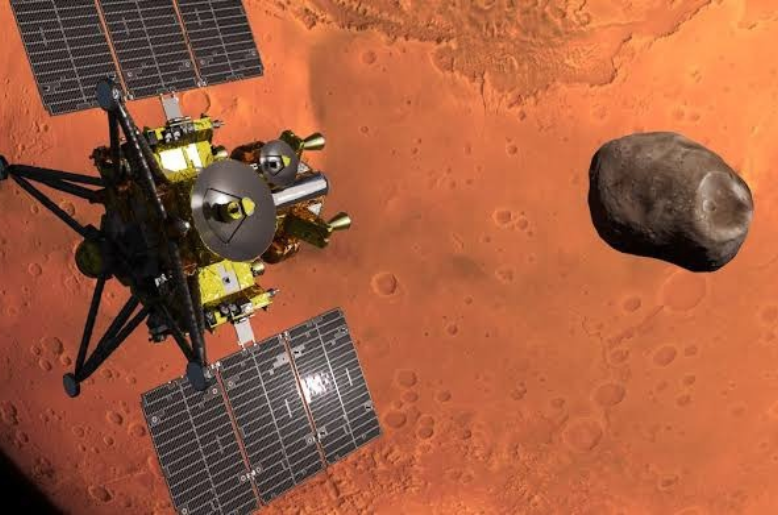
Japan has launched a spacecraft to study Mars’ mysterious moons and bring samples back to Earth. The mission, called Martian Moons eXploration (MMX), aims to collect material from Phobos. Japan’s Aerospace Exploration Agency (JAXA) leads this international space project. The spacecraft launched aboard an H3 rocket from Tanegashima Space Center on October 20, 2026. The launch marks an important step in efforts to understand the origins of Mars’ two moons. If successful, the mission will return samples to Earth in 2031.
Japan’s MMX Mission targets Mars’ Mysterious Moon
Japan’s MMX mission aims to return samples from Phobos and help scientists answer major questions about the Martian system. Phobos is the larger and closer of Mars’ two moons. It has an irregular, potato-like shape and measures about 22 kilometers across. Scientists still do not know exactly how Phobos and Deimos formed. One theory suggests that a massive collision created both moons. Another possibility is that Mars captured asteroids with its gravitational pull. Material collected from Phobos could help scientists determine which explanation is more likely. The samples may also contain traces of Mars itself. This could provide valuable information about the planet’s geological history.
How will the MMX Spacecraft collect samples?
The MMX mission will use a spacecraft and a small rover to examine Phobos. The spacecraft is expected to reach Mars in 2027. It will then study the moons and prepare for its sampling operations. A French-German rover named Idefix will travel to Phobos ahead of the main sampling operation. The rover will examine the surface and help identify suitable locations. This will help mission controllers avoid dangerous terrain and loose soil.
The main spacecraft will later descend to the moon’s surface. Its lander will use drilling and collection equipment to gather material. The mission aims to collect at least 10 grams of dust, soil, and rock. The sampling operation is planned for 2028 or 2029. The spacecraft will also observe Deimos during flybys before beginning its return journey.
When will the Phobos samples return to Earth?
Japan’s MMX mission aims to return samples from Phobos by 2031. After completing its observations and collection work, the spacecraft will leave the Martian system in 2030. The return journey will carry the collected material toward Earth. Mission planners expect the sample capsule to land in the Australian desert. Scientists will then examine the material in laboratories to study its composition and history. Japan has previous experience with asteroid sample-return missions. Its Hayabusa and Hayabusa2 missions successfully brought material from asteroids to Earth. This experience could help JAXA manage the technical challenges of the MMX project.
Why is the MMX Mission important?
The mission could provide new evidence about how the Martian moons formed. It may also help scientists understand how Mars and the surrounding solar system developed. Researchers hope to determine whether Phobos formed from material thrown into space during an impact or originated as a captured asteroid. Studying samples directly could offer stronger evidence than observations from spacecraft alone.
The project also involves international cooperation. NASA and European space agencies are contributing scientific instruments, technology, and other support. Their participation allows researchers from several countries to study the findings. The mission could also guide future robotic and crewed missions to Mars. Better knowledge of the Martian environment may help scientists plan future exploration efforts. However, its scientific results will depend on the samples collected and the evidence they reveal.
What comes next for Japan’s Space Mission?
The spacecraft must complete its journey to Mars, examine the moons, and collect suitable samples. Each stage presents technical challenges, especially landing on Phobos, where gravity is extremely weak. A successful return would mark a major milestone in planetary science. It would provide researchers with the first material collected directly from a moon of Mars.
For now, scientists will monitor the spacecraft as it begins its long journey. The mission’s findings could help answer longstanding questions about the origins of Phobos and Deimos.