
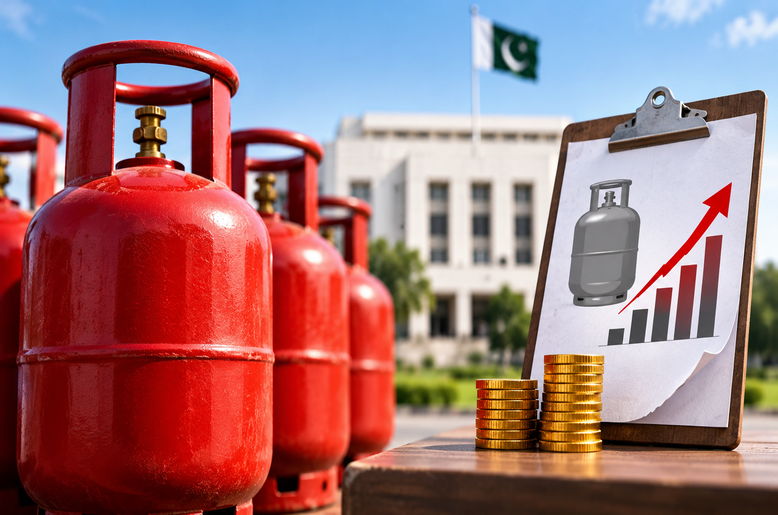
The federal government has proposed major changes to Pakistan’s liquefied petroleum gas (LPG) pricing system.
The Oil and Gas Regulatory Authority (OGRA) would stop announcing monthly LPG prices, under the proposed policy.
The changes were initially planned for November 1, 2026, but final approval remains pending.
Prime Minister Shehbaz Sharif has formed a committee to review the reforms before implementation.
How will the new LPG pricing system work?
State-owned companies, including Pakistan State Oil (PSO), SSGC LPG Limited, PARCO Pearl Gas Limited, and Pakistan LNG Limited, would import LPG in large quantities.
These companies would announce monthly base prices using Saudi Aramco’s benchmark, shipping charges, insurance, import premiums, taxes, and other expenses.
Currently, OGRA calculates LPG prices using the Saudi benchmark and a fixed margin of Rs35,000 per metric ton.
The Petroleum Division says this formula does not properly reflect import expenses.
Between January and July 2026, filling-plant prices exceeded official consumer rates by Rs60 to Rs79 per kilogram. In March, the difference reached Rs158.
Private LPG companies could determine their marketing margins and transportation charges, under the proposal.
However, OGRA and the Competition Commission of Pakistan would monitor unfair competition and price manipulation.
Subsidies for poor families and LPG supply plans
The government also proposes establishing a Producer-Price Differential Fund to support low-income households.
Money collected from the difference between domestic producer prices and import-based prices would finance targeted subsidies.
Families meeting Benazir Income Support Programme eligibility requirements could receive financial assistance.
The Petroleum Division would finalize the fund’s operating procedures within one month.
The government also plans to reserve 10 per cent of locally produced LPG for supplying Gilgit-Baltistan, northern regions, and remote mountainous areas.
The remaining 90 per cent would be distributed through monthly auctions to approved companies.
Pakistan’s annual LPG market is approximately 2.4 million metric tons, with demand growing around 7.5 per cent annually.
About 71 per cent of supplies come from imports, increasing pressure on the country’s limited storage and transportation facilities.
Officials estimate that approximately $1 billion in investment will be required over the next three to five years to expand terminals, storage, cylinders, and transportation infrastructure.
Meanwhile, OGRA has notified a November LPG price of Rs294.07 per kilogram, showing that the proposed deregulation has not yet fully taken effect.
