
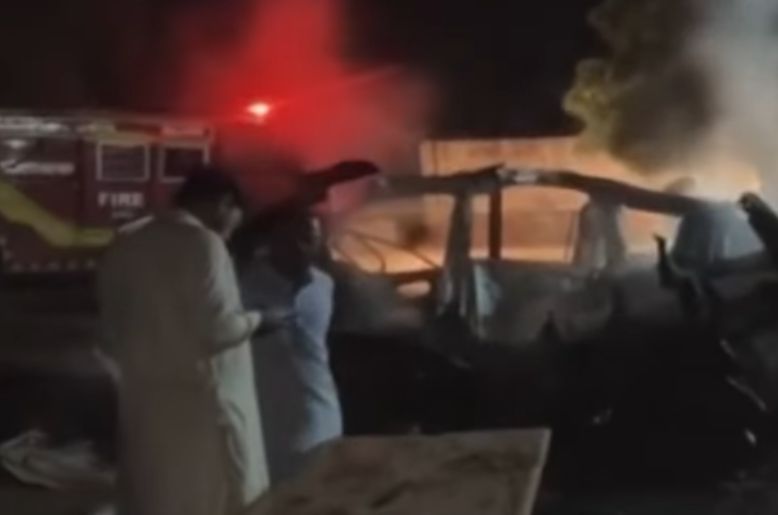
The deaths of eight people in an ambulance cylinder blast in Tharparkar have raised questions about safety standards, maintenance and the performance of the Sindh government led by the Pakistan Peoples Party (PPP).
Eight people have been killed, and five others injured after an ambulance caught fire outside a hospital in Dano Dandal, Nagarparkar, in Sindh’s Tharparkar district.
Police said the fire broke out after a cylinder installed in the ambulance exploded.
Five injured people are receiving medical treatment, according to the latest information provided.
Deputy Commissioner and police officials are present at the scene.
The cause of the incident has not been independently confirmed.
The incident comes amid wider concerns about public infrastructure, healthcare facilities and municipal services in the province.
Bilawal Bhutto-Zardari, who has referred to himself as the “Son of Karachi”, has also spoken about provincial unity, saying the Sindh Assembly had “put a full stop on the division of provinces”.
So, what happens when Sindh needs his attention? Such major incidents have occurred, but what action has been taken so far? Is the so-called “Son of Karachi” asleep?
However, such incidents have raised questions that whether the government’s public statements are being matched by improvements in public services.
The ambulance fire has prompted concerns about whether the cylinder involved was properly inspected and maintained. The type of cylinder and the exact cause of the incident still need to be confirmed by the relevant authorities.
Questions have also been raised about the reported discovery of expired morphine injections at the National Institute of Cardiovascular Diseases (NICVD) and persistent waste-management problems in Karachi, including those associated with the Karachi Metropolitan Corporation (KMC).
The government should focus on improving healthcare safety, public infrastructure and municipal services rather than concentrating solely on political statements.
The phrase “We promise, we deliver” has become a point of criticism, with opponents asking what tangible improvements residents of Sindh have seen in their daily lives.
While criticism has circulated in media reports and social media posts, the extent of public dissatisfaction and the government’s response to these specific allegations would need to be independently assessed.
The incidents have renewed calls for greater accountability and for the provincial government to demonstrate measurable improvements in public services.

