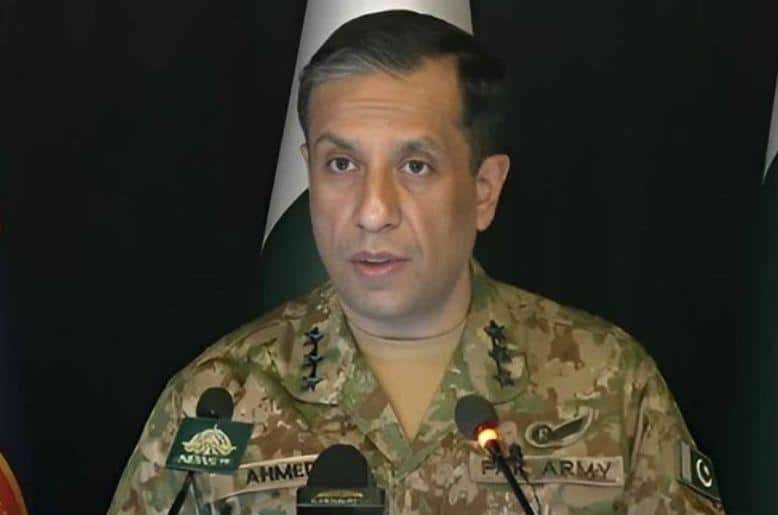
Pakistan has defeated India in a multi-domain war in May last year, Director General of the Inter-Services Public Relations Lieutenant General Ahmed Sharif Chaudhry said.
DG ISPR Lieutenant General Ahmed Sharif Chaudhry, along with the deputy chief of naval staff (operations), Rear Admiral Shafaat Ali, and the deputy chief of air staff (projects), Air Vice Marshal Tariq Ghazi, addressed a presser on the first anniversary of Marka-e-Haq against India.
DG ISPR said one of the major outcomes of Marka-e-Haq was the collapse of India’s narrative portraying Pakistan as a sponsor of terrorism. He said India had attempted to accuse Pakistan of involvement in terrorist activities without presenting any evidence.
He stated that a year had passed after the Pahalgam incident but the questions raised by Pakistan still remained unanswered. “Where is the evidence?” he asked, adding that the international community no longer accepted India’s allegations and instead viewed India itself as a source of instability and terrorism.
He said that immediately after the Pahalgam incident, an FIR was registered within minutes and claims were made that the attackers had come from outside India. However, no concrete evidence has been presented so far.
According to the DG ISPR, if Indian intelligence was truly effective and informed, it should have known in advance about people allegedly entering from hundreds of kilometres away. He questioned where Indian institutions were at the time and what role they were playing.
He said the international community was still asking who was behind the Pahalgam incident and what the motive was. He added that not only the people of Pakistan but also informed circles within India were seeking answers
He stated that India repeatedly accused Pakistan of terrorism, but after “Marka-e-Haq” this “drama” had been buried forever. According to him, the world was now witnessing for itself who was actually contributing to instability in the region.
The DG ISPR said Pakistan demonstrated great responsibility during “Marka-e-Haq” and kept tensions under control. He said Pakistan prioritised regional peace and prevented the situation from becoming more dangerous.
He added that the world also saw Pakistan playing the role of a responsible state by helping control tensions and maintain regional stability, while India continued trying to endanger the region through emotional statements, political motives and provocative behaviour.
He further said the second major consequence of the conflict was Pakistan’s emergence as a key security stabiliser in the region. According to DG ISPR, Marka-e-Haq demonstrated which side maintained control over escalation, while accusing India of intensifying tensions based on false claims.
The DG ISPR maintained that Pakistan and its leadership had proven to be the strongest advocates of peace and security in the region.
Ahmed Sharif Chaudhry said India had long attempted to portray itself as a “net security provider” in the region, but during “Marka-e-Haq” the international community saw the reality with its own eyes. He said that if any country was sincerely working for regional stability today, it was Pakistan.
The DG ISPR said several examples of India’s so-called professional military thinking had emerged over the past year. According to him, some statements by Indian military leadership appeared political rather than professional.
He said the Indian military leadership seemed to be transferring political narratives into military institutions, while Pakistan’s armed forces maintained a completely professional approach throughout the period. According to DG, no Pakistani military officer ever adopted provocative language based on political statements, whereas statements by Indian politicians often appeared to create a war-like atmosphere.
He said Indian leaders repeatedly used provocative slogans and aggressive rhetoric, but Pakistan responded with responsibility, restraint and professionalism at every stage. The DG ISPR said if India had objections or disagreements on any issue, it should address them directly and responsibly instead of making provocative statements.
He further stated that India faced both internal and external challenges but attempted to shift responsibility for those issues onto others. Ahmed Sharif Chaudhry said the treatment of Muslims, Christians and other minorities in India, including in Kashmir, was visible to the world. He added that the situation in Manipur and other areas had also remained concerning, yet India continued accusing Pakistan.
DG ISPR said the Kashmir issue was an internationally recognised dispute with existing United Nations resolutions. According to him, despite demographic changes, legal measures and other Indian actions, the Kashmir dispute still remained unresolved.
The DG ISPR said whenever India faced internal or external problems, it revived the terrorism narrative. He added that India often blamed others for various incidents and at times even used incidents within its own country for political purposes.
He said this was not a new strategy and that India had followed the same pattern for a long time.
Ahmed Sharif Chaudhry further said Pakistan gained practical experience of different dimensions of modern warfare during “Marka-e-Haq” and “Bunyan-un-Marsoos.”
He said modern warfare was no longer confined to traditional battlefields but had become multidimensional, extending across air, land, sea, cyber, information and even human minds. According to him, the effects of such warfare were felt in cities, villages, streets and among ordinary civilians. He said modern conflict involved not only weapons but also information, narratives and psychological influence.
The DG ISPR said Pakistan faced all these challenges and demonstrated preparedness and an effective strategy on every front. He said Pakistan was prepared before the conflict, remained fully active during it and continued to stay ready for all threats.
Ahmed Sharif Chaudhry said Pakistan clearly conveyed during “Marka-e-Haq” that no compromise could be made on national defence and that the country possessed full capability to respond strongly to any aggression.
He added that Pakistan was prepared for every challenge and would respond effectively and immediately to any hostile action.
According to the DG ISPR, the vision of Pakistan’s founder Muhammad Ali Jinnah remained alive today that no conspiracy or aggression against Pakistan could succeed.
He said “Marka-e-Haq” delivered a message to the world that Pakistan was united and strong regarding its sovereignty, security and defence, and that this position was increasingly being recognised internationally.
