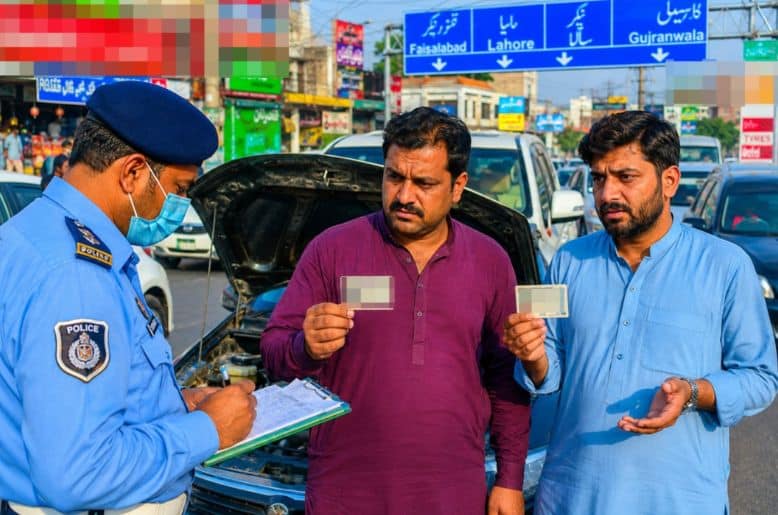
The Punjab Traffic Police have announced that the driving licences of motorists operating smoke-emitting vehicles will be suspended as part of a stricter crackdown on environmental pollution.
Chief Traffic Officer (CTO) Syed Abdul Rahim Shirazi said the authorities will also suspend the route permits of commercial vehicles found violating emission standards.
He added that tractor-trolleys without tarpaulins and dumpers are prohibited from entering Lahore, with 1,013 cases registered against violators so far.
The CTO said 45 special teams have been deployed at the city’s entry and exit points to monitor vehicles and ensure compliance with environmental and traffic regulations.
According to Shirazi, traffic police issued challans to 3,649 smoke-emitting vehicles and 2,183 pollution-causing vehicles during the current month. Action was also taken against 6,820 vehicles operating without valid fitness certificates or in dilapidated condition.
He reiterated that tractor-trolleys will not be allowed on roads without tarpaulins, water sprinkling arrangements, and other mandatory safety measures.
The CTO further said that smoke-emitting vehicles are also being detected and fined with the help of an artificial intelligence (AI)-based monitoring system.
Earlier, the Khyber Pakhtunkhwa (KP) government introduced a digital driving licence service for the first time, allowing citizens to store their licences on their mobile phones.
According to Chief Traffic Officer (CTO) Peshawar Dr. Zahid Ullah, the facility has been launched through the “Rabta” mobile application. Citizens can obtain a legally valid digital driving licence within seconds by entering their CNIC number and driving licence number in the app.
He said the initiative eliminates the need to carry a physical driving licence at all times, as the e-licence displayed on a mobile phone will now be accepted during traffic checks.
Officials said the move is part of the KP Traffic Police’s digital governance policy, aimed at providing citizens with faster, more convenient, and technology-driven public services.
