
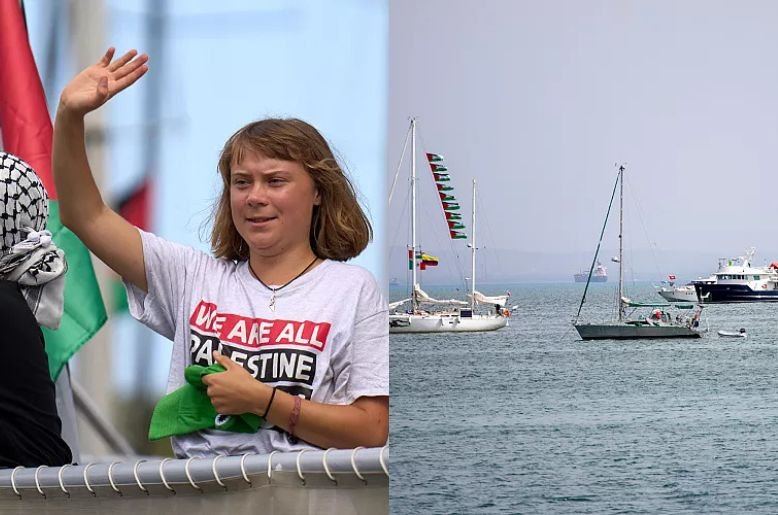
Israel intercepted vessels from the Global Sumud Flotilla and began transferring passengers to an Israeli port, despite the convoy describing itself as a civilian aid mission.
Protests broke out in Athens, Rome, Berlin, Brussels, and Tunis after the Israeli military intercepted flotilla vessels
Protests erupt in capitals of Europe and North Africa after flotilla interception by the aggressor Israeli military.
Demonstrators gathered outside embassies and city squares in their respective countries, calling for safe passage for aid boats and an immediate ceasefire.
Organisers urged European and regional governments to pressure Israel and open monitored humanitarian corridors to Gaza.
Police monitored the rallies, which were largely peaceful, though brief scuffles were reported near embassy perimeters.
Global Sumud Flotilla key developments today
- One Gaza-bound vessel is still sailing toward the Strip, after Israeli forces intercepted dozens of other boats carrying aid.
- Italy’s largest union has called a general strike on Friday to back the flotilla; 22 Italian activists were part of the convoy.
- The European Union welcomed President Trump’s Gaza plan and urged Hamas to accept it, saying the EU is ready to contribute with its available tools.
- Russia’s President Vladimir Putin said he will support Trump’s proposal if it leads to a two-state solution, an idea Israel has long rejected.
PM Shehbaz condemns Israeli action on Samud Gaza flotilla, urges release of detainees
Prime Minister Shehbaz Sharif strongly condemned what he called a dastardly attack by Israeli forces on the 40 vessel Samud Gaza flotilla, which he said carried more than 450 humanitarian workers from 44 countries.
He said Pakistan hopes and prays for the safety of all those apprehended and called for their immediate release, noting that their only act was to deliver aid to the Palestinian people.
The prime minister said this brutality must end and that peace should be given a chance. He stressed that humanitarian assistance must reach civilians without obstruction.
He also urged the international community to support safe passage for aid and to uphold principles that protect relief missions in conflict zones.
Protesters shut down Berlin train station in protest against the attack on the flotilla vessels
Demonstrators in Berlin shut the city’s central train station to protest the interception of flotilla vessels near Gaza, disrupting services as crowds chanted and waved flags.
At the same time, protests erupted in Athens, Rome, Istanbul, and Tunis, where marchers called for safe passage for aid boats and an immediate ceasefire.
The rallies followed a wider wave of activism across Europe.
Just three days ago, thousands in Germany gathered in solidarity with Palestine, setting the stage for today’s escalations and adding pressure on European leaders to respond.
Israeli military detains Greta Thunberg as navy stops Gaza bound aid flotilla
Israeli officials confirmed that Greta Thunberg’s aid vessel was intercepted near the Gaza Strip.
The Global Sumud Flotilla said three boats were boarded, and Israel’s foreign ministry posted a clip showing Thunberg detained.
The flotilla declared a high alert and called the Israeli military operation an illegal interception.
It said cameras went offline and that organisers are working to verify the safety and status of all participants.
What is a flotilla, and how is it linked to Gaza’s humanitarian aid?
A flotilla is a formation of group of vessels sailing together for a shared mission. The term comes from Spanish and often describes civilian convoys in today’s coverage.
Activists use flotillas to travel in groups for safety, visibility, and coordination.
In Gaza’s case, the link began with the 2010 Gaza Freedom Flotilla, a six ship effort that later formed the Freedom Flotilla Coalition.
Since then, follow on attempts in 2011, 2015, 2016, 2018, and in June and July 2025 were all intercepted by Israeli forces.
In August 2025, the coalition joined the Global Sumud Flotilla and launched new convoys toward Gaza to deliver symbolic aid and challenge the blockade.
Interception of a civilian convoy raises legal and moral concerns about humanitarian access
Activists reported that Israeli naval craft approached with transponders off and ordered boats to cut engines.
Organisers said the Alma and Sirius were among the vessels halted.
The flotilla counts nearly fifty boats and about five hundred participants, including Greta Thunberg and Mandla Mandela. It carries a symbolic amount of aid to highlight blocked access to Gaza.
Israel says aid should move through other channels where IDF has more authority. Critics counter that diverting a peaceful convoy silences visibility, delays relief caused by IDF soldiers, and treats humanitarian volunteers as suspects rather than partners.
Israel brands the voyage a provocation while evidence for security claims remains thin
Foreign Minister Gideon Sa’ar called the flotilla a provocation and urged a return to port.
Officials also alleged links between some participants and Hamas in order to halt humanitarian aid, a tactic Israeli government use to coerce Palestinian’s. Activists rejected the claims and demanded proof.
European reactions were split. Italy instead siding with the relief efforts warned the voyage could complicate recent diplomacy. Spain described the mission as humanitarian and not a threat.
If Israel wants credibility, rights groups argue, it should allow neutral inspection, publish cargo findings, and let verified supplies proceed under supervision instead of seizing boats at sea.
Blockade enforcement cannot erase obligations to facilitate relief under international law
Law of the Sea rules limit coastal jurisdiction, while wartime blockades claim exceptions.
Israeli scholars say interception can be lawful if a blockade is militarily justified and a ship intends to breach it.
Humanitarian law experts reply that when basic needs are unmet, states must enable relief corridors from the high seas with monitoring and searches that are proportionate and transparent.
Israel already checks truck cargo at land crossings. Extending a similar inspected corridor for sea deliveries would better balance security with urgent civilian needs.
By choosing coercive stoppage over supervised passage, Israel undermines trust and fuels the very crisis it has started that humanitarian missions seek to ease.


