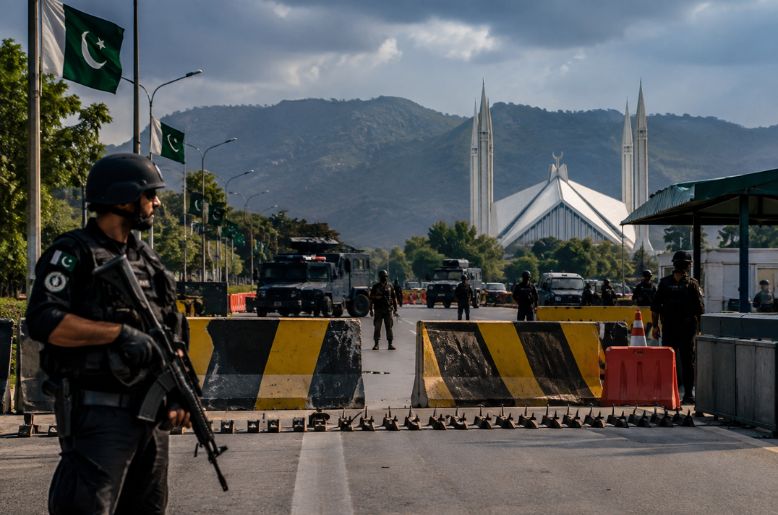
Islamabad entry points are being closed with containers and barbed wire as security is placed on high alert ahead of a Pakistan Tehreek-e-Insaf (PTI) long march led by Khyber Pakhtunkhwa (KP) Chief Minister (CM), Sohail Afridi, following the collapse of talks between the government and the opposition.
Authorities have positioned containers along major roads and around the Red Zone, while additional barriers are being prepared for key entry points into the capital.
Key locations reported to have been affected by the security measures include Tarnol Interchange, Sangjani, 26 Number Chungi, Srinagar Highway, Iran Avenue, T-Chowk on the Rawat side, Faizabad and the Red Zone.
Containers have been positioned at several of these points to restrict or control the movement of vehicles approaching Islamabad.
Police personnel from Sindh have already arrived in Islamabad, with additional personnel from Punjab on standby as officials prepare for the arrival of PTI supporters.
The federal government has also extended the deployment of Rangers in Islamabad until 15 October, with about 3,000 personnel expected to remain stationed in the capital.
The measures reflect official concerns that the planned march could lead to clashes or disruption, particularly given the history of violent confrontations during previous PTI protests.
Interior Minister Mohsin Naqvi has accused Sohail Afridi of being responsible for the failure of negotiations, saying the government had sought to resolve the dispute through talks but that the process ultimately collapsed.
Speaking in a press briefing, Mohsin Naqvi said he would hold Sohail Afridi responsible if anyone lost their life during the confrontation.
He also warned that the government would not allow a repeat of the violence associated with the events of 9 May.
The latest confrontation follows several rounds of negotiations between government and opposition representatives.
The talks failed to produce an agreement, with disagreements reportedly including demands for access to jailed former prime minister and PTI founder ISohailan Khan, as well as security and counter-terrorism issues.
Sohail Afridi had previously indicated that he was open to dialogue, but he subsequently remained committed to the PTI’s planned march.
His decision to proceed after the negotiations has drawn strong criticism from the government, which portrays the march as an unnecessary escalation at a time of heightened security concerns.
