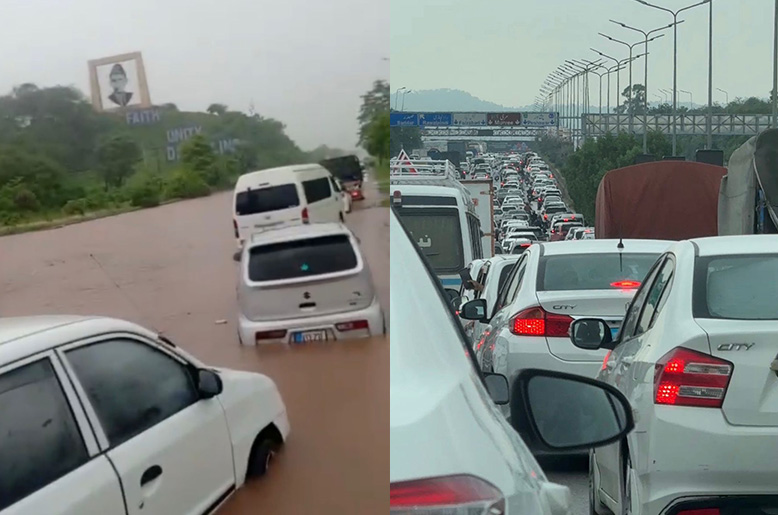
Tuesday’s rain once again exposed what thousands of commuters describe as one of the capital’s biggest everyday challenges, the worsening traffic congestion on Islamabad Expressway.
For office workers and students travelling from Rawalpindi and adjoining areas to Islamabad, the morning commute turned into an hours-long ordeal as heavy rainfall led to water accumulation on roads and underpasses, bringing traffic to a near standstill.
Long queues of vehicles stretched across key sections of the expressway, leaving commuters stranded as they struggled to reach their offices, educational institutions and workplaces on time.
The disruption particularly affected residents travelling from DHA Phase II, DHA Phase III, DHA Phase V, Rawat, Jinnah Garden, River Garden, Soan Garden, PWD Housing Society, Bahria Town Phase IV and other localities that rely on Islamabad Expressway as the primary route into the federal capital.
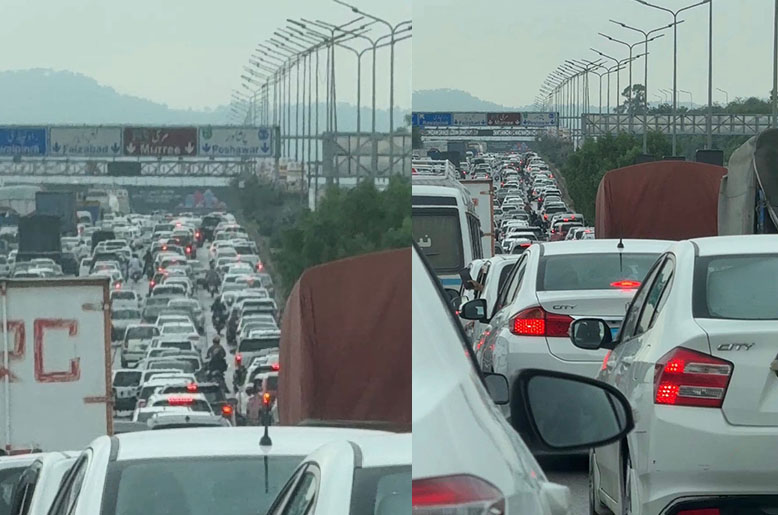
While Tuesday’s congestion was triggered by rain, commuters say traffic chaos has become a daily reality regardless of the weather.
On ordinary days, they point to a combination of VIP movements, road closures, vehicle breakdowns, accidents and heavy vehicles as recurring causes of severe congestion. Many believe the growing problem requires a comprehensive traffic management system instead of temporary measures.
One of the most problematic stretches, according to motorists, is between Japan Road and Faizabad, where slow-moving trucks often occupy lanes and make overtaking difficult, further reducing traffic flow during peak hours.
Although Islamabad Traffic Police personnel were deployed at several locations on Tuesday, commuters said their presence did little to ease the congestion. Water accumulated beneath underpasses forced many motorcyclists to stop under bridges, creating additional bottlenecks that further slowed traffic.
“The traffic situation in Islamabad has never been this bad,” said a banker who has been commuting daily from DHA Phase II to the Red Zone for the past 10 years.
“On normal days it can take up to one and a half hours to reach the office. Today the rain made it worse, but on other days it could be a broken-down car in the middle of the road, trucks blocking lanes or some other disruption. Every day there is a new reason.”
Beyond delays, commuters say the cost of travelling has also increased significantly.
Residents of PWD, DHA Phase II and areas near Faizabad say ride-hailing services frequently charge more than Rs1,600 during rush hours, making daily travel increasingly unaffordable for many workers.
Public transport offers little relief. Finding a seat in Toyota Hiace vans during peak hours is often difficult, while bus routes remain unclear to many passengers. Even after waiting for long periods, commuters say there is no guarantee they will be able to board because of overcrowding.
With Islamabad’s population continuing to grow and more people commuting daily from neighbouring housing societies, residents believe improving traffic management, expanding reliable public transport and addressing recurring bottlenecks on Islamabad Expressway have become urgent priorities rather than long-term goals.
Read next: Heavy rain hits Rawalpindi, Islamabad