
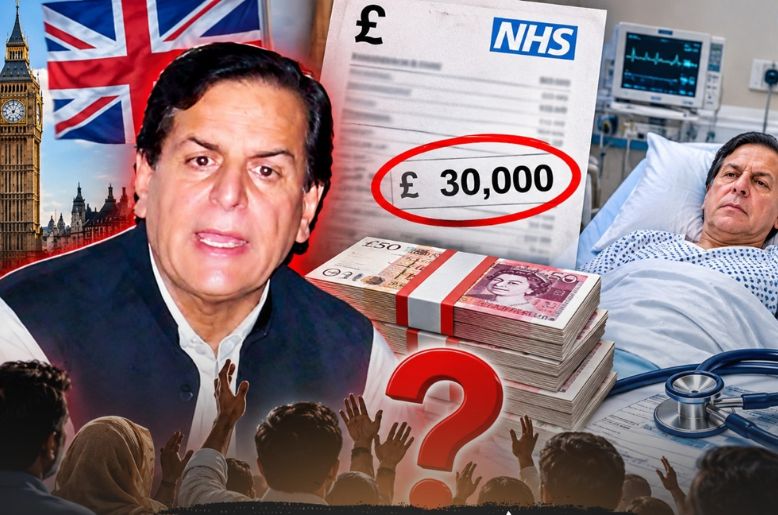
Javed Hashmi frequently speaks about political principles, support for democracy and moral values. However, an issue linked to his political past has raised serious questions. Today, he leaves no opportunity to criticise national and accountability institutions, but records from his time in power and political history raise questions about whether his much-publicised principles and ethical standards were limited to television cameras and political speeches.
According to a report published in a leading Pakistani newspaper, during the 2008–2013 government, particularly under former Prime Minister Yousaf Raza Gillani, ministers, parliamentarians and bureaucrats were sent to some of the most expensive hospitals in the United States, the United Kingdom and Germany for treatment at public expense. The reported cases involved conditions and procedures such as diabetes, back pain, fever, speech therapy and angioplasty, some of which could reportedly be treated locally. The name of Javed Hashmi, who frequently advocates political principles, also appeared in this context.
The political record of leaders who make grand claims and portray themselves as champions of democracy is often scrutinised when they hold positions of power. While ordinary citizens struggle to access healthcare facilities within the country, critics argue that some political figures have benefited from publicly funded treatment abroad, involving thousands of pounds and dollars.
Javed Hashmi’s treatment in London at public expense
According to the report, in 2010, then Prime Minister Yousaf Raza Gillani approved £30,000 for Makhdoom Javed Hashmi to receive rehabilitation and speech therapy in the United Kingdom. The amount was equivalent to several million Pakistani rupees.
Notably, when the Finance Division approved the funds for Hashmi’s expensive treatment abroad, he was associated with the Pakistan Muslim League-Nawaz (PML-N). This has also prompted questions about his political affiliations and the use of public resources during a government led by a rival political party.
Although different statements and explanations subsequently emerged regarding the matter, the report has brought renewed attention to the official record of the funding. Critics argue that questions remain about the use of public money for overseas medical treatment, particularly when comparable medical services may have been available in Pakistan.
The central issue, however, is accountability. If Hashmi considers himself a champion of democracy, transparency and ethical politics, he should clearly explain his position on the matter and provide details of the publicly funded treatment, including the circumstances surrounding the approval and expenditure.
The public deserves answers about how the money was authorised, why treatment abroad was considered necessary and what information is available in the official record. Those who repeatedly invoke political principles must also be prepared to answer questions about their own use of public funds.
Criticising institutions while facing questions over public funds
Hashmi has frequently criticised corruption and spoken out against national institutions. His critics, however, question the moral standing of politicians who benefited from publicly funded facilities or overseas medical treatment during their time in power but now challenge the actions of accountability institutions.
The question being raised is whether political leaders who received financial benefits from the public exchequer should explain their own records before questioning the impartiality of institutional proceedings.
Critics argue that attacks on institutions should not distract from legitimate questions about the use of public money, and that the same standards of transparency and accountability should apply to every politician, regardless of party affiliation.
The controversy has therefore renewed calls for Hashmi to clarify the circumstances surrounding the reported £30,000 approval and address questions about his political record.
Public officials and political leaders are expected to demonstrate transparency in the use of state resources. Where questions arise over publicly funded benefits, the appropriate response is to provide documentary evidence and a clear explanation rather than allow allegations to remain unresolved.
