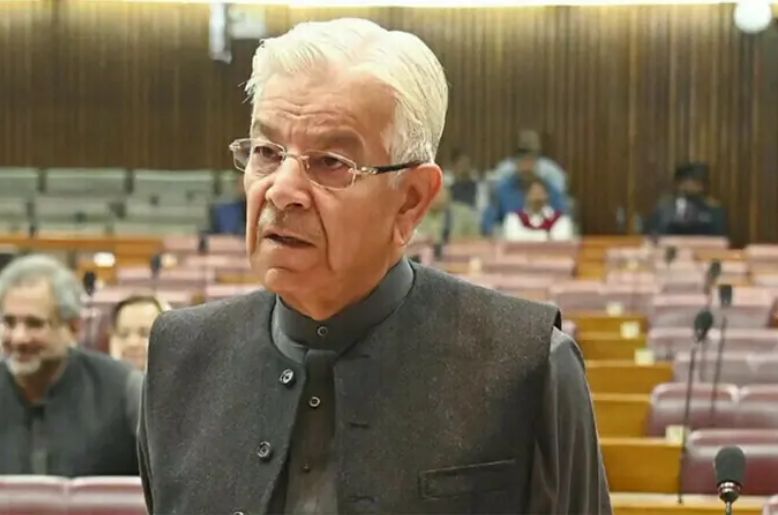
Defence Minister Khawaja Muhammad Asif has said the duration of Governor’s Rule and the state of emergency imposed in Khyber Pakhtunkhwa (KP) will be determined in accordance with the Constitution and applicable laws. Defending the federal government’s decision in Parliament, Asif described the move as a last resort after other options and efforts to achieve political reconciliation had failed.
Under Article 234 of the Constitution, Governor’s Rule initially remains in force for two months unless approved for extension by a joint sitting of Parliament. It can be extended in periods of up to two months, but cannot exceed six months in total. Meanwhile, Article 232 governs the imposition of a state of emergency. When the President issues an emergency proclamation without a resolution from the provincial assembly, it must be approved by both houses of Parliament within 10 days.
It must also be presented before a joint sitting within 30 days and lapses after two months unless approved by the joint sitting. Once approved, it remains in force until revoked or rejected in accordance with the Constitution. The two measures have separate constitutional procedures and time limits, with their continuation subject to the relevant parliamentary approvals.
Meanwhile, Khawaja Muhammad Asif has accused Pakistan Tehreek-e-Insaf (PTI) of failing to openly condemn terrorism, alleging that the party views the Pakistani state as an adversary while maintaining links with the Afghan Taliban.
Speaking on the floor of the House, Asif claimed that Khyber Pakhtunkhwa’s provincial leadership had been taking instructions from an individual based in Afghanistan. He also criticised the PTI-led provincial government’s performance over the past 13 years, saying governance and the law and order situation had deteriorated. The defence minister described terrorism as the country’s most pressing challenge and called on the provincial government to stand firmly with security forces combating militancy.
Citing figures to support his argument, Asif claimed that approximately 2,900 terrorist incidents had occurred during an earlier three-year period, compared with 3,700 incidents recorded last year. He challenged the PTI to present statements in which its leaders had condemned terrorism or expressed solidarity with the country’s security institutions.
Referring to attempts to engage militants in dialogue, the minister said the interior minister had explained in the Senate how the negotiations had failed. He also criticised the opposition’s stance on negotiations and security-related matters.