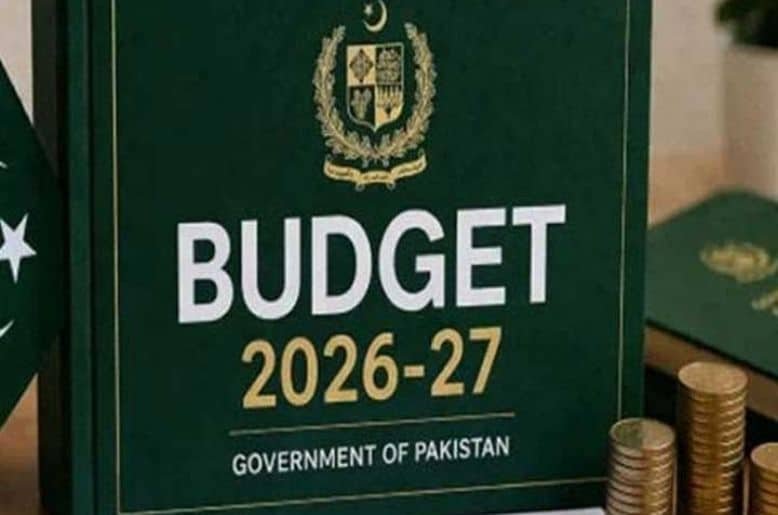
Finance Minister Muhammad Aurangzeb on Friday presented the federal budget for FY2026-27, outlining a Rs18.771 trillion spending plan aimed at maintaining economic stability while increasing development spending, strengthening defence and expanding social protection programmes.
Presenting his third budget speech in the National Assembly, Aurangzeb said the government had inherited a difficult economic situation but had managed to steer the country towards stability over the past two years.
He pointed to what he described as improvements in key economic indicators, including economic growth of 3.7 percent, lower inflation, stronger foreign exchange reserves and remittances that are expected to exceed $41 billion.
The finance minister said Pakistan’s economy is projected to grow by 4 percent in the next fiscal year, while average inflation is expected to remain at 8.2 percent. The budget deficit has been set at 3.6 percent of gross domestic product, with the government targeting a primary surplus of 2 percent of GDP.
Debt servicing remains biggest expense
Budget documents showed that debt servicing will continue to take up the largest share of federal spending.
Out of the total expenditure of Rs18.771 trillion, Rs8.054 trillion has been allocated for markup payments. This includes Rs6.983 trillion for domestic debt and Rs1.071 trillion for external debt obligations.
The government has earmarked Rs3 trillion for defence spending, describing national security as one of its top priorities.
Pension payments are estimated at Rs1.169 trillion, while Rs1.091 trillion has been allocated for subsidies, including support for the power sector. Civil administration expenses have been budgeted at Rs1.071 trillion.
The finance minister said the government had reviewed the impact of rising global oil prices but had chosen not to pass on the full burden to consumers. Instead, targeted relief measures had been introduced to protect vulnerable groups from higher energy costs.
Grants worth Rs2.68 trillion have been proposed for initiatives including the Benazir Income Support Programme (BISP), Azad Jammu and Kashmir, Gilgit-Baltistan and the merged districts of Khyber Pakhtunkhwa.
The budget also includes Rs430 billion for emergency and contingency requirements.
On the revenue side, the Federal Board of Revenue (FBR) has been assigned a tax collection target of Rs15.264 trillion, which is 17.6 percent higher than the ongoing fiscal year’s estimate.
Non-tax revenues are projected at Rs5.336 trillion. After transferring Rs8.848 trillion to provinces under the NFC arrangement, the federal government’s net revenues are expected to stand at Rs11.751 trillion.
Aurangzeb said the federal and provincial governments had agreed on a mechanism under Article 164 of the Constitution to help meet strategic national requirements without affecting provincial rights under the 7th NFC Award.
For development spending, the government has allocated Rs1 trillion under the federal Public Sector Development Programme (PSDP).
The broader national development programme approved by the National Economic Council totals Rs3.675 trillion. It includes Rs2.224 trillion for provincial development schemes and Rs451 billion for investment by state-owned enterprises.
More than 60 percent of the federal PSDP will be directed towards transport, water and energy projects.
The transport sector has been allocated Rs365 billion, including Rs100 billion for the N-25 Pakistan Expressway linking Karachi and Chaman. Another Rs30 billion has been proposed for the M-6 Sukkur-Hyderabad Motorway, while Rs25 billion has been earmarked for the Karachi-Rohri section of the ML-1 railway project.
In the energy sector, Rs116.2 billion has been allocated for projects including the Dasu Hydropower Project, the Tarbela fifth extension and the Mohmand Hydropower Project.
The government has also proposed expanding social protection initiatives. Funding for BISP has been increased to Rs838 billion, up 17 percent from the previous year.
Under the expansion plan, the BISP Kafaalat programme will cover 12 million families, while educational stipends are expected to benefit around 9.2 million children.
In addition, Rs71 billion has been allocated for the Prime Minister’s Apna Ghar Scheme, while Rs88 billion has been set aside to expand the Export Refinance Scheme to support exporters.
This is a developing story and will be updated as more details emerge…
