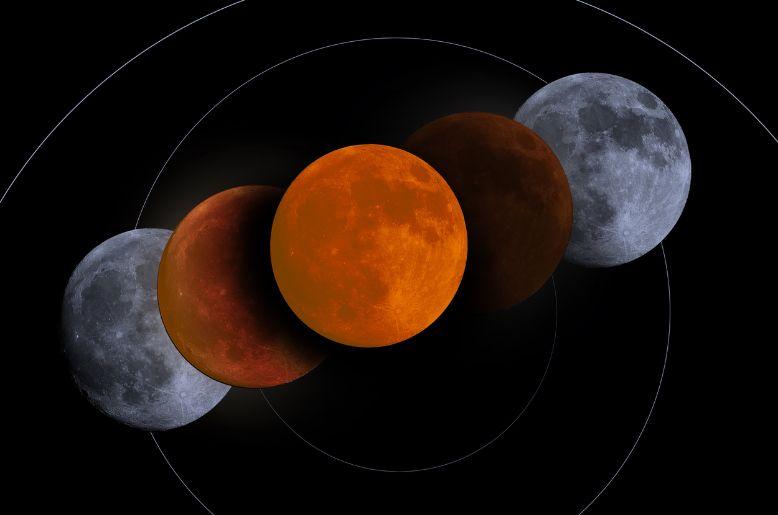
Earth’s shadow will cover about 96% of the Moon’s surface overnight on August 27-28, creating a striking partial lunar eclipse that could give the Moon a deep crimson or reddish appearance.
The celestial event will take place as Earth moves between the Sun and the Moon during the full Moon phase.
As the eclipse progresses, Earth’s curved inner shadow, known as the umbra, will gradually move across the lunar surface.
At the peak of the eclipse, only a thin portion of the Moon will remain outside the shadow and continue receiving direct sunlight.
The eclipse will be visible to an estimated 3.3 billion people across large parts of North and South America, as well as sections of Europe and Africa.
However, visibility will depend on the observer’s location and local conditions. Although the different stages of the eclipse occur at the same moment worldwide, the local time at which they appear will vary.
For observers along the western coast of the United States, including Los Angeles and Portland, the eclipse will reach its maximum just a few hours after sunset, providing a convenient opportunity to watch the event.
Meanwhile, people on the US East Coast, including those in New York and Jacksonville, will see the eclipse reach its peak around midnight local time.
The reddish colour occurs because sunlight passing through Earth’s atmosphere is filtered and refracted toward the Moon, with longer red and orange wavelengths more likely to reach its surface.
This effect can make the eclipsed Moon appear dramatically crimson against the night sky.
Also read: Eclipse today: why millions are looking to the skies