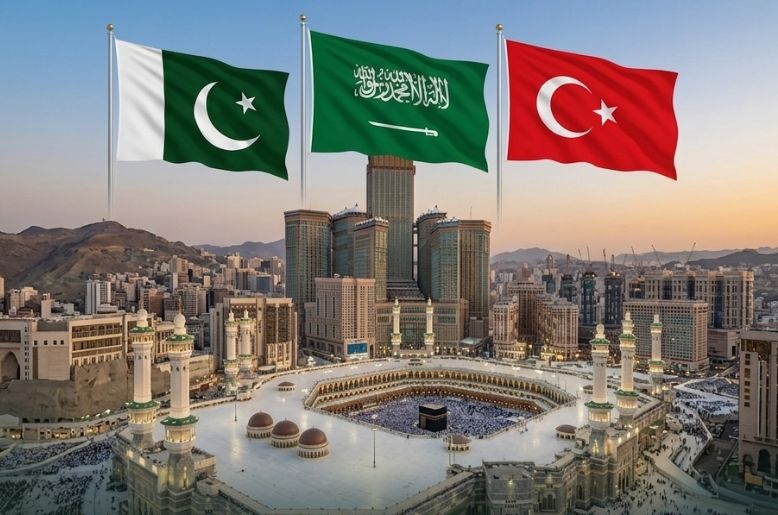
India’s former ambassador to the United Nations, T. S. Tirumurti, has shared a post on the social media platform X, formerly Twitter, in which he said that the Makkah Joint Defence Agreement is ‘not good news for India.’
Talking about the recent regional developments, he said that they are proving his earlier assessment.
In his post, Tirumurti wrote that soon after the Iran war began at the end of February, he had written in The Hindu on March 10 that “Türkiye, Saudi Arabia and Pakistan will benefit. Their ambitions and stock will rise to fill the regional space. This is not good news for India.” He added that this is now “coming true.”
.@sidhant Soon after the Iran war started end February, I had written the following in @the_hindu of 10 March: Türkiye, Saudi Arabia & Pakistan will benefit. Their ambitions and stock will rise to fill the regional space. This is not good news for India
Now this is coming true. https://t.co/kMGeXm8cdZ— Amb T S Tirumurti (@ambtstirumurti) August 7, 2026
Tirumurti previously served as India’s Ambassador to the United Nations in New York and as Secretary to the Government of India. He is currently the Chair of the Steering Committee at the Deccan Centre.
Makkah Joint Defence Pact
Pakistan, Saudi Arabia, and Türkiye have officially signed the landmark joint defence agreement today, Pakistan’s Ministry of Foreign Affairs confirmed.
According to the Foreign Office, the agreement formalises decades of close ties among the three countries and establishes a framework for enhanced defence collaboration based on mutual trust, shared interests and regional stability.
Makkah Al-Mukarramah Summit for Joint Defence.
At the gracious invitation of the Custodian of the Two Holy Mosques King Salman bin Abdulaziz Al Saud, the President of the Republic of Türkiye, H.E. Mr. Recep Tayyip Erdoğan, and the Prime Minister of the Islamic Republic of… pic.twitter.com/tYwKZq2EKK— Prime Minister’s Office (@PakPMO) August 7, 2026
The Foreign Office highlighted the complementary strengths of the three nations, citing Pakistan’s experienced armed forces and strategic capabilities, Saudi Arabia’s economic strength and regional influence, and Türkiye’s advanced defence technology and industrial base.
It further said the partnership would enhance defence cooperation while creating a balanced regional security architecture capable of responding to future challenges.
The FO also described Pakistan as an emerging regional stabiliser, pointing to its diplomatic engagement with countries across the region and its ability to maintain constructive relations with global powers. It said Islamabad’s strategic position enables it to play the role of a trusted bridge between regional and international stakeholders.
