
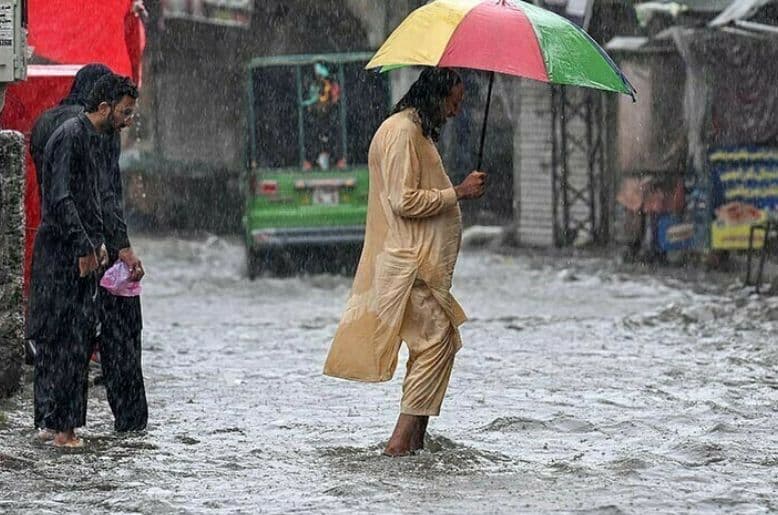
A fresh spell of monsoon rains is expected to enter Pakistan from today, July 18, with the Pakistan Meteorological Department (PMD) forecasting thunderstorms across the country’s upper and central regions through July 25. The weather agency has also issued alerts for urban flooding and landslides as the monsoon system is likely to intensify during the period.
According to the PMD, the monsoon system is expected to intensify, bringing thunderstorms to Islamabad, Rawalpindi, various parts of Punjab, Khyber Pakhtunkhwa, and Azad Jammu and Kashmir. Rain is particularly expected in Islamabad from July 20 to 23.
Heavy rainfall may trigger urban flooding in Rawalpindi, Lahore, Gujranwala, Sialkot, Faisalabad, and Multan. The Meteorological Department has also warned of a heightened risk of landslides in Murree, Galiyat, Azad Jammu and Kashmir, Swat, Chitral, Kohistan, and Gilgit-Baltistan from July 20 to 25.
Flash flooding is possible in hilly and mountainous areas, while strong winds and lightning may damage weak or vulnerable structures. The PMD has advised tourists to avoid unnecessary travel to affected areas and urged the public to take precautionary measures. It has also directed all relevant authorities to remain on high alert and ensure that preventive measures are in place to deal with any emergencies.
Meanwhile, due to the intense heat and high humidity prevailing across the country, the Meteorological Department has issued a heatstroke alert for several regions.
In many cities, the combination of high temperatures and humidity has caused the heat index, or “feels-like” temperature, to reach extremely dangerous levels.
According to the Meteorological Department, the actual temperatures in Peshawar, Quetta, Bahawalnagar, Dera Ismail Khan (DI Khan), and Joharabad ranged between 40°C and 42°C. However, because of the high humidity, the heat index in these areas exceeded 54°C.
Similarly, Sargodha recorded an actual temperature of 40.5°C, while the heat index reached 52.8°C. Gujranwala and Kot Addu also experienced a heat index of 52.5°C.
In other cities, Okara recorded an actual temperature of 40.5°C, with a heat index of 51.5°C. Meanwhile, Attock’s actual temperature was 38°C, but the heat index rose to 49.8°C, making conditions feel significantly hotter than the recorded temperature.
Read more: PAEC Chairman urges young scientists to become tech innovators
