Operation Bunyan-um-Marsoos, meaning ‘a wall of solid lead,’ was launched by Pakistan against India on May 7, 2025, after unprovoked aggression from the other side.
The name may be hard to pronounce and understand, but the operation itself marked an important moment in history which changed strategies and set new standards.
The term means “a solid wall of lead,” and Pakistan’s actions reflected this meaning.
What happened on May 7, 2025
Six Indian jets were shot down on May 7. These include three Rafales, one SU-30, and one MiG-29. Seven drones were also shot down in Sialkot and Kotli Loharan.
Multiple Indian Army sites were damaged, including a Brigade Headquarters, 6 Mahar Battalion HQ, and several checkpoints such as Jungle 1 post, Shahpur 3, Chura post, Dharamsal 1 and 2 posts, Battal sector, Jabri post opposite Chirikot sector, Chakoti sector, Sarla 1 post, Sanghar post, Giddar post, Chatri post, Gol Tekri (Kot Kothera sector), Kinari Mor post (Nezapure sector), Leepa sector, Siri Top Mandal post, and Khakli Tekri post. Overall casualties included 26 civilians martyred, 46 civilians injured, and four military personnel injured.
What happened on May 8, 2025
On May 8, Pakistan shot down 22 Indian drones, bringing the total number of destroyed drones to 29.
Officials also reported casualties. These included three civilians martyred, three civilians injured, and two military personnel injured.
A joint press conference was held by the Deputy Prime Minister and the DG ISPR to discuss the situation.
Meanwhile, Lt Gen Muhammad Saeed (Retd), in an interview with Sky News, strongly denied claims that the families of terrorists were killed in Pakistan.
What happened on May 9, 2025
On May 9, the DG ISPR presented detailed evidence of what Pakistan described as Indian state-sponsored terrorism during a tri-services press conference.
He also said that a BrahMos missile was neutralised through both soft kill and hard kill measures. Officials stated that 48 more Indian drones were shot down. This brought the total number to 77. Casualties reported included four civilians martyred, 13 civilians injured, and eight military personnel injured.
A separate tri-services briefing was also held with foreign correspondents to discuss the ongoing situation.
Meanwhile, Minister of State for Foreign Affairs of Saudi Arabia Adel al-Jubeir arrived in Islamabad for talks with the Pakistani leadership on the escalating tensions.
The DG ISPR also gave an interview to TRT World regarding what Pakistan called Indian aggression.
What happened on May 10, 2025
On May 10, Pakistan said it responded to India’s attack with retaliatory strikes, targeting multiple military installations at different locations inside India.
Later in the day, a ceasefire was announced by both sides at 4:30 PM Pakistan Standard Time (PST).
Brilliance of Pakistan forces
Pakistan’s Army, Air Force, and Navy proved their brilliance to the world, proving to be one of the best among all, which to this day is being acknowledged both nationally and internationally.
Even the US Congress has formally acknowledged Pakistan’s victory over India, according to the reports. This even reflects today, as the president of the United States (US), Trump, expresses great respect for the country, Prime Minister Shehbaz and Chief of Army Staff and Chief of Defence Forces, Field Marshal Syed Asim Munir.
The Pakistan Institute for Conflict and Security Studies (PICSS) reported that there are three phases of the ongoing India-Pakistan conflict in 2025.
In the first phase, the report says, India launched Operation Sindoor against Pakistan on the night of May 7-8, 2025.
In its initial strike, India carried out 24 missile attacks on six Pakistani cities: Muzaffarabad, Ahmed Pur East, Kotli, Muridke, Sialkot, and Shakargarh.
These attacks resulted in the deaths of many civilians, including children and women.
India designated this operation as a response to the Pahalgam false flag that occurred on April 22 in the Indian illegally occupied Kashmir (IIOJK). India, which many observers believe to be habitual, blamed Pakistan.
However, India has failed to provide any evidence of Pakistan’s involvement in the Pahalgam attack to date, even after launching the strikes against Pakistan.
In the second phase, India launched drones towards Pakistan on the night of May 8-9, the report adds. This happened despite Pakistan’s warning to exercise caution. While 90 drones were neutralised, Pakistan remained silent and did not retaliate.
In the third phase, during the night of May 9-10, India targeted three bases in Pakistan: Noor Khan Airbase, Shorkot Airbase, and Murid Airbase. However, all these attacks were intercepted.
In response, Pakistan announced Operation Bunyan-um-Marsoos and warned India to “wait for our response.”
The launch of Bunyan-um-Marsoos
Within minutes, Pakistan retaliated with missile strikes against India, successfully targeting several locations. According to the reports, the following Indian sites were destroyed
- Beas: BrahMos Missile depot
- Udhampur: S-400 Air Defence System
- Pathankot Airbase
- Logistics HQ
- Jalandhar Airbase and its infrastructure
- Nagrota BrahMos Launch site
- Akhnoor Brigade HQ
- Uri Supply Depot
- Srinagar Northern Command HQ
- Chandigarh Weapons Depot
- Sirsa Airbase
- Military Intelligence HQ Rajuri
In addition to this, another round of air dogfight continued.
- Three Rafale jets were shot down over Sialkot, Lahore, and Kashmir.
- One Rafale jet was downed near Sialkot.
- Drone strikes were conducted over Jammu and Kashmir, Punjab, Rajasthan, and border areas.
- These include the following
- Pathankot
- Pokhran
- Amritsar
- Ferozepur
- Fazilka
- Lalgarh
- Jaisalmer
- Barmer
- Bhuj
- Kurabet
- Lakhi Nalla
- Hoor Maniya
- Hisar among others
The role of Indian Media
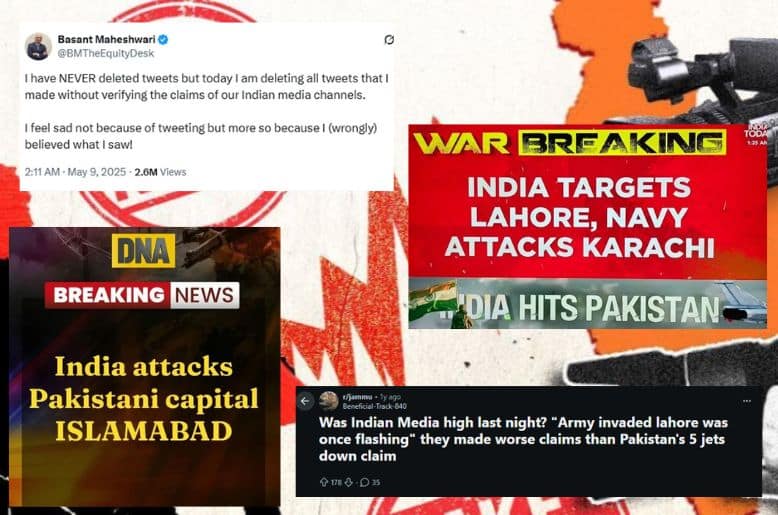
Indian media created a ‘frenzy.’ It claimed that it carried out aircraft, drone, and missile attacks across the international border.
Pakistan rejected these claims as false and responded that there was no electronic evidence, no captured pilots, and no proof but only media reports.
DG ISPR Lieutenant General Ahmed Sharif Chaudhry sarcastically thanked Indian media for providing entertainment to the Pakistani public. He mocked the continued coverage of Pakistan's Navy search for 'Lahore port'.#PakistanConnect pic.twitter.com/ZqUN5xZ0rp
— P Connect (@ConnectingPak) May 7, 2026
It was also said that India attacked its own cities and blamed Pakistan for targeting civilians. In response, Pakistan stated it would not carry out hidden attacks. Instead, it would inform India before striking, saying that not only India but the whole world would witness it.
The false reports were so excessive and odd that they sparked backlash from within India itself. Basant Maheshwari publicly apologised for sharing unverified news, stating, “I have NEVER deleted tweets, but today I am deleting all tweets that I made without verifying the claims of our Indian media channels. I feel sad not because of tweeting but more so because I (wrongly) believed what I saw!”
Role of media, Gen Z
Federal Minister for Information and Broadcasting Attaullah Tarar said that Pakistan’s youth, especially Gen Z and social media influencers, along with mainstream media, played an important role in strengthening the country’s narrative during Marka-e-Haq.
Speaking at an event marking one year of the success of Marka-e-Haq, the minister praised the youth, social media influencers, and digital users, saying their efforts would be remembered in golden words in history.
“Alongside conventional warfare, there was also a digital front where our Gen Z and social media users played a remarkable role. Their efforts helped counter misinformation, strengthen national morale and project Pakistan’s stance effectively,” he said.
“We could not have achieved this without the support of social media platforms and mainstream media. It was a collective effort and true teamwork of the entire nation,” he added.
“It is by the grace of Almighty Allah that one year after Marka-e-Haq, a clear distinction has emerged in the world. On one side stands Pakistan-post May 10, 2025-where at the governmental, public, diplomatic, narrative and military levels, the country enjoys respect, dignity and recognition globally,” he said.
He further added that the Pakistani passport and the green crescent flag were being respected internationally.
