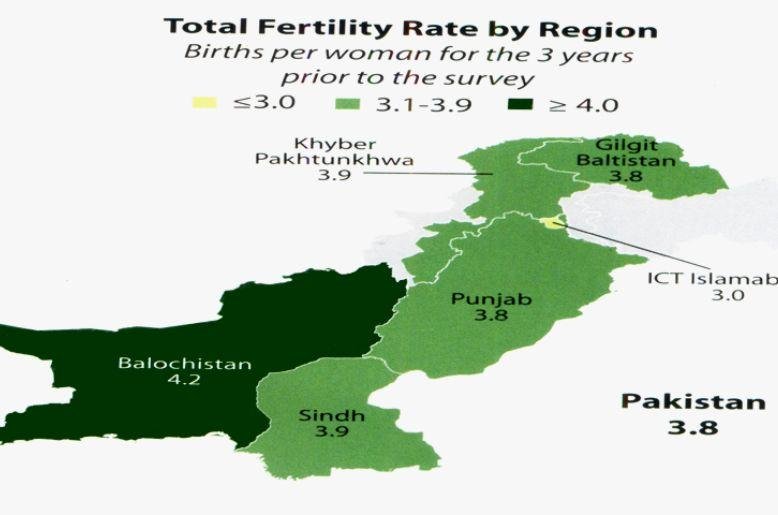
Pakistan’s fertility rate plays a critical role in shaping the country’s population, society, and economy. In 2023, the total fertility rate in Pakistan was approximately 3.6 births per woman, showing a gradual decline from 3.66 in 2022 and over 6 in the 1990s. Despite this decline, Pakistan’s fertility rate remains higher than many neighboring countries in the region. The continued high proportion of young people, nearly 40.3% under age 15, ensures population momentum, leading to rapid growth even as fertility rates fall.
Understanding the Pakistan fertility rate is crucial for policy planning, healthcare, and social services. This article provides a simple and clear guide on the topic, including historical trends, causes, effects, and solutions.
Historical trends of Pakistan fertility rate
Pakistan’s fertility rate has declined significantly over the last few decades. In the early 1990s, the average woman gave birth to over 6 children. By 2023, this number decreased to around 3.6 births per woman.
The decline is linked to increased awareness of family planning, urbanization, and rising education levels among women. However, the decrease is slow compared to global averages. Pakistan still has one of the highest fertility rates in South Asia.
This high fertility contributes to a large youth population, which can either become a demographic dividend or a challenge depending on access to education, healthcare, and employment.
Current fertility rate and population growth
Pakistan’s current fertility rate of 3.6 births per woman sustains a population growth rate of approximately 2.55% per year. This growth adds around 5 million people annually to the country’s population.
Despite declining fertility, population momentum is strong because a large portion of the population is young. Many households still have multiple children, and unmet family planning needs remain high. These factors ensure that Pakistan’s population will continue growing rapidly in the coming decades.
The high growth rate puts pressure on resources, including schools, hospitals, housing, and employment opportunities. Managing this growth is critical for sustainable development.
Factors affecting Pakistan fertility rate
Several factors influence Pakistan’s fertility rate. One of the main reasons is the low contraceptive prevalence rate, which is only 34% among married women. Around 17.8% of women have an unmet need for family planning, meaning they want to avoid pregnancy but lack access to contraceptives.
Cultural and religious beliefs also affect fertility decisions. In some communities, large families are preferred, and women have limited autonomy in reproductive choices.
Education is another key factor. Women with higher education levels tend to have fewer children. Urbanization also contributes to lower fertility as city life increases costs and changes family priorities.
Government policies and awareness campaigns are gradually improving access to family planning, but challenges remain in rural and underserved areas.
Regional comparison of fertility rates
Pakistan’s fertility rate is higher than neighboring countries like India, Bangladesh, and Iran. While India has a rate of around 2.0 and Bangladesh 2.1, Pakistan remains at 3.6.
Higher fertility means faster population growth, which affects the country’s economy, healthcare system, and employment market. Managing fertility through awareness, education, and family planning is essential to align Pakistan with regional trends.
Social impact of high fertility
High fertility affects society in multiple ways. Large families often face financial stress, limited access to healthcare, and educational challenges for children.
Women with multiple pregnancies may experience health complications, including maternal mortality and anemia. Children may face malnutrition or limited educational opportunities due to family size.
Rapid population growth also strains infrastructure, housing, and public services in urban areas. Planning schools, hospitals, and social programs becomes more challenging with high fertility and population growth.
Economic impact of fertility rate
Pakistan’s high fertility rate influences the economy significantly. A large youth population can be an asset if they receive education and job opportunities, creating a demographic dividend.
However, if job creation and education do not keep pace with population growth, it can lead to unemployment, poverty, and increased demand for social support. Public resources, such as healthcare and education, face additional strain with each generation.
Managing fertility through family planning and social programs can improve economic outcomes by balancing population growth with resource availability.
Policies to managed fertility rate
Pakistan has implemented policies to manage fertility, such as promoting contraceptive use, increasing access to healthcare, and encouraging education for women. The government and NGOs conduct awareness campaigns to inform citizens about family planning.
Providing affordable and accessible contraceptives is crucial. Educating communities about the benefits of smaller families and improving healthcare infrastructure can further help reduce fertility rates sustainably.
Urbanization and economic development also play a role. Families in cities tend to have fewer children due to higher costs and lifestyle changes. Read our full report on Nearly Rs30,000 monthly allowance announced for unmarried women to know who is eligible and how to apply.
Outlook for Pakistan fertility rate
The Pakistan fertility rate is expected to decline gradually in the coming decades. Continued education, urbanization, and family planning programs can accelerate this trend.
However, population momentum will maintain growth for some time because of the already large base of young people. Planning for this growth is essential for sustainable economic development and social stability.
If Pakistan manages fertility effectively, it can leverage its young population as a demographic dividend, boosting economic growth and improving living standards.
Conclusion
Pakistan’s fertility rate has declined from over 6 births per woman in the 1990s to around 3.6 in 2023. Despite this reduction, high fertility continues to drive rapid population growth. It affects society through financial pressure, health risks, and education challenges, while influencing the economy through resource demand and potential unemployment.
Managing fertility through family planning, education, and healthcare improvements is essential for Pakistan’s sustainable growth. Addressing cultural, social, and economic barriers can help citizens make informed reproductive choices and benefit society and the economy in the long term.
Frequently asked questions
1. What is Pakistan fertility rate in 2023?
Pakistan’s fertility rate is approximately 3.6 births per woman in 2023.
2. Why is Pakistan fertility rate high?
Low contraceptive use, cultural norms, and limited education contribute to high fertility.
3. How does fertility rate affect Pakistan’s economy?
High fertility increases demand for jobs, education, and healthcare, impacting economic stability.
4. What is the ideal fertility rate for Pakistan?
A fertility rate around 2.1 births per woman can help achieve population stability.
5. How can fertility rate be reduced?
Through family planning, education, awareness campaigns, and access to healthcare.