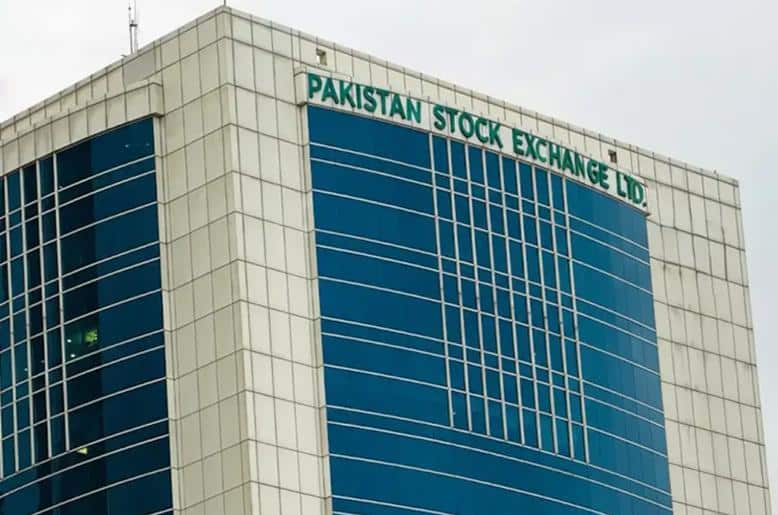
The Pakistan Stock Exchange came under strong selling pressure on April 30, with the benchmark KSE-100 Index falling sharply during intraday trade as investors reacted to rising global risks and weak sentiment.
By around 12:40 PM, the index was hovering at 162,274.07, down by 3,549.80 points or 2.14 percent from the previous close of 165,823.87. Earlier in the session, losses were even steeper, with the market dropping over 4,200 points at one stage.
Trading remained highly volatile throughout the morning. The index moved between a high of 164,357.47 and a low of 160,391.18, showing wide swings as investors struggled to find direction. Total traded volume in the benchmark index crossed 196 million shares, pointing to heavy activity during the sell-off.
Market participation showed a clear tilt towards declines. Only a handful of companies managed to post gains, while the overwhelming majority closed in negative territory. This imbalance reflected weak investor confidence and a broad-based exit from equities.
Among individual stocks, Youw and several others faced steep losses, with declines reaching around 10 percent in some cases. Other laggards included Aruj, ESBL and UDLI, all of which also saw sharp drops. On the other hand, a few stocks such as MSCL, SHCM and BPL managed to record strong gains, each rising close to or above 10 percent, offering limited support to the market.
Active stocks painted a similar picture. WorldCall Telecom, Cnergyico, Bank of Punjab and Pace Pakistan all traded lower, while only a small number of names showed positive movement during the session.
Heavyweight stocks played a key role in pulling the index down. Major names in banking, fertiliser and energy sectors remained under pressure, which added to the overall decline. These sectors, which usually carry significant weight in the index, saw consistent selling throughout the day.
Sector-wise, commercial banks, oil and gas exploration companies, fertiliser producers, cement firms and investment companies were among the biggest contributors to the downturn. Some support came from select smaller stocks, but it was not enough to offset the broader weakness.
The negative trend followed a fragile previous session, as global developments continued to unsettle investors. International oil prices surged, with Brent crude reaching a four-year high amid growing tensions between the United States and Iran. Concerns about possible supply disruptions have raised uncertainty across global markets.
At the same time, reports that the UAE plans to exit the OPEC alliance have added another layer of concern. The move has raised questions about future coordination among major oil producers, especially at a time when markets are already facing instability.
These developments have increased risk aversion among investors, leading to selling pressure across emerging markets, including Pakistan. The KSE-100 Index, despite posting a strong one-year gain of over 45 percent, remains down nearly 6.8 percent so far this year, highlighting the recent weakness in market performance.
Read next: PSX jumps nearly 5,000 points in early trade