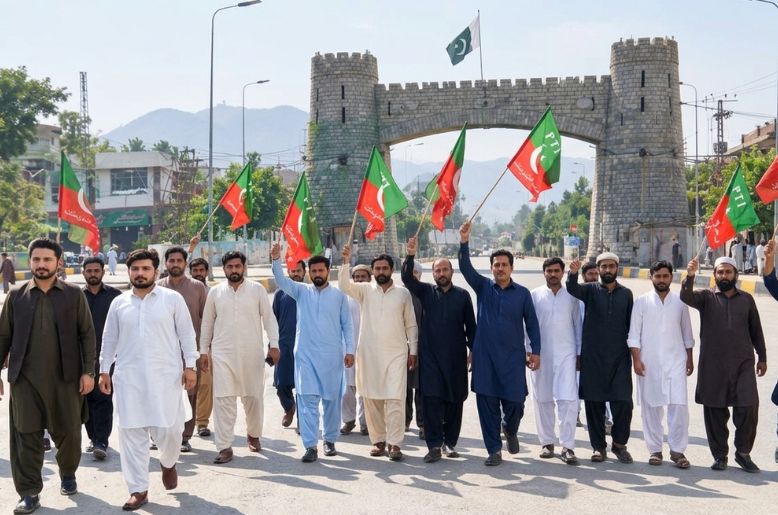
The Pakistan Tehreek-e-Insaf (PTI) has faced questions over its claims of mass public support after reports of low turnout at protests in Peshawar and Jamrud, the hometown of Khyber Pakhtunkhwa Chief Minister Sohail Afridi.
The reported gatherings have raised questions about the party’s ability to mobilise supporters on the streets, particularly as political tensions continue in the province following developments surrounding emergency measures and the governor’s rule.
Political popularity is often tested not only through rallies and social media campaigns but also through a party’s ability to bring supporters onto the streets. The reported turnout in these two locations has provided ammunition to critics who argue that PTI’s claims of widespread public support do not always translate into large protest gatherings.
Low turnout reported in Peshawar
Peshawar, a major urban centre and a key political stronghold of PTI, reportedly witnessed a turnout of just 16 people in response to a protest call.
The figure, if accurate, contrasts sharply with the party’s repeated claims of commanding widespread public support across the country.
The reported turnout has prompted questions about the whereabouts of the large crowds often invoked by PTI leaders and supporters during political speeches and social media campaigns.
Critics argue that the limited participation reflects growing public fatigue with repeated protests, road closures and political confrontation. However, turnout at a single demonstration does not, by itself, establish the overall level of a party’s popularity.
Only 30 protesters reportedly gather in Jamrud
A similarly small gathering was reported in Jamrud, in Khyber district, the home area of Chief Minister Sohail Afridi.
According to the figures cited in the original account, around 30 people attended the protest despite PTI’s political representation in the area, which includes Afridi and other elected lawmakers.
The reported turnout has raised questions about the party’s local mobilisation efforts, particularly given its political presence in the district.
The original account also alleges that some participants appeared more interested in recording TikTok videos than in demonstrating. This characterisation, however, has not been independently verified.
For PTI’s critics, the gatherings provide an opportunity to challenge the party’s image as a political force capable of mobilising large numbers of supporters at short notice.
Public concerns extend beyond political protests
The limited gatherings have also renewed debate over the issues facing residents of Khyber Pakhtunkhwa.
Residents across the province face concerns over security, terrorism, economic hardship and access to basic services. Critics of PTI argue that political leadership should prioritise these issues instead of relying heavily on street protests and political confrontation.
They maintain that people want lasting peace, improved economic conditions and effective governance rather than repeated disruptions to everyday life.
At the same time, the size of individual demonstrations should not be treated as conclusive evidence of public opinion. Factors such as the timing of a protest, its location, organisational arrangements and the wider political environment can all influence attendance.
Normal activities resume amid political tensions
Meanwhile, the original account reported that routine activities had resumed in parts of Khyber Pakhtunkhwa following developments involving emergency measures and the governor’s rule.
Traffic was reportedly moving on roads, shops and commercial centres were operating, and the restoration of mobile phone services had helped residents resume communications.
The account interpreted these developments as signs that people were weary of PTI’s protest politics. However, the return of routine activities alone does not establish the political preferences of the wider population.
The reported gatherings in Peshawar and Jamrud nevertheless offer a point of political debate for a party that frequently emphasises its grassroots support.
