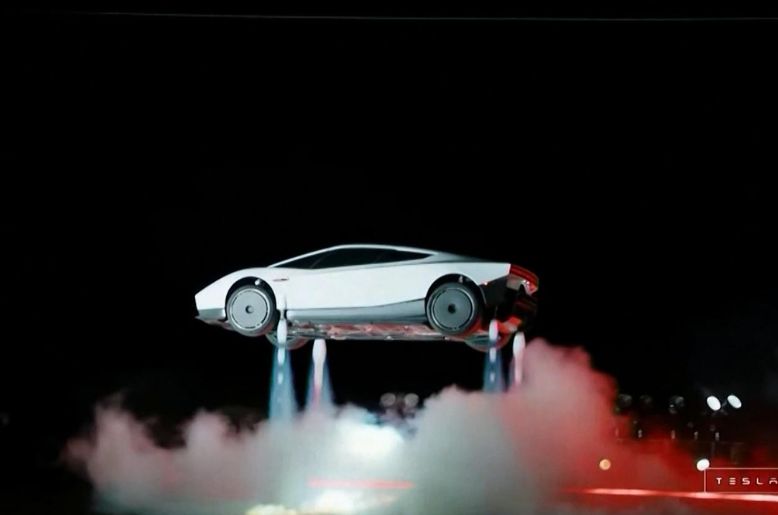
Tesla CEO Elon Musk unveiled a new Roadster sports car at a SpaceX test facility in Texas on Thursday, demonstrating a vehicle capable of jumping over parked cars, briefly taking to the air and accelerating from zero to 60 mph (97 km/h) in less than a second. However, its ability to sustain flight over longer distances remains unproven.
The two-seat vehicle was presented as a flying car powered by high-pressure air jets designed to improve acceleration on the road and enable aerial manoeuvres.
During the driverless demonstration, the Roadster climbed a steep ramp using suction technology beneath the vehicle, hung upside down and spun off the structure before landing with the help of air jets. It later jumped over a row of parked Tesla vehicles, showcasing its rapid acceleration using jets positioned at the rear.
Musk said the demonstration was conducted without a driver for safety reasons, acknowledging the risks associated with the technology. “Success is not guaranteed,” he told the audience, explaining that spectators had been kept at a safe distance.
Air-powered technology raises questions
According to Musk, the Roadster uses 10 nozzles connected to ultra-high-pressure air tanks to generate thrust. He described the system as a collaboration between Tesla and SpaceX and said the vehicle was expected to enter production in 2028, although previous Tesla projects have faced delays.
Despite the demonstration, the vehicle did not establish that it could remain airborne for extended periods or travel significant distances through the air.
Roger Connor, curator for vertical flight at the Smithsonian’s National Air and Space Museum, told CNN that combining aircraft and road vehicle requirements presents major engineering challenges. Aircraft must minimise weight, while cars need protective structures such as bumpers and crumple zones.
California-based startup Alef has also developed a vehicle capable of vertical lift using eight propellers, although its lightweight design accommodates only one passenger.
Alef CEO Jim Dukhovny said achieving lift-off was technically feasible, but maintaining stability while transitioning to forward movement remained a major challenge. Connor similarly questioned whether a road-legal sports car could achieve sustained flight, suggesting Tesla’s demonstration showed a vehicle capable of hopping rather than genuinely flying.