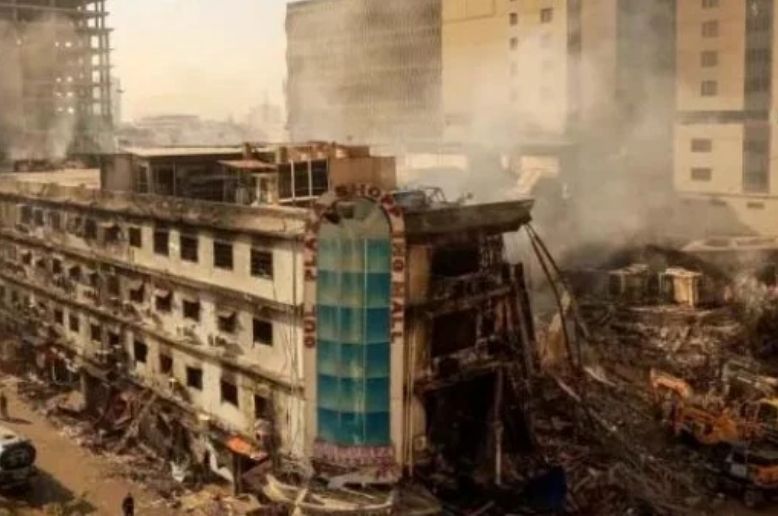
The inquiry commission investigating the Gul Plaza fire has issued its report, holding multiple institutions and individuals responsible for the tragedy that claimed more than 72 lives. The report termed the incident a collective failure of the system, blaming successive provincial and local governments for failing to enforce fire safety regulations and address longstanding safety violations.
According to the report, most of Gul Plaza’s escape routes were blocked or obstructed when the fire broke out. Of the building’s 16 designated escape routes, only two to four were reportedly accessible, severely limiting the ability of people to evacuate safely.
Windows were covered with grilles and blocked by equipment and other obstacles. The building also lacked essential fire safety systems, including fire alarms, smoke detectors and sprinklers. Basic firefighting infrastructure such as hydrants, hose reels and fire pumps was also missing.
The commission said the authorities had previously identified fire safety deficiencies but failed to take corrective action. Recommendations made in fire safety audits were also not properly implemented. The approved plan for Gul Plaza provided for 1,102 shops, but the building actually contained 1,153 shops, according to the report. The commission said the probable cause of the fire was children playing with matches. It noted that the fire was believed to have started after matches were burned at Shop No. 193. However, the commission did not conclusively determine the cause because a forensic report was unavailable.
The commission said the effective firefighting response began around 35 to 40 minutes after the fire started, despite the fire brigade’s own stated response time of six to seven minutes. The delay resulted in the loss of valuable time that could have been used for rescue operations.
The Deputy Commissioner South and district administration were also criticised for failing to implement an effective fire safety audit mechanism. The Sindh Building Control Authority (SBCA) was blamed for failing to ensure the continuous implementation of fire safety regulations at Gul Plaza.
The commission concluded that the Gul Plaza tragedy was the result of a combination of known hazards, poor management, weak enforcement and inadequate rescue arrangements. It said legal powers, fire safety audits and rescue mechanisms were already in place, but the overall system failed to function effectively. According to the report, people lost their lives not only because of the fire but also because of delayed responses, darkness, blocked routes and ineffective safety and rescue systems.