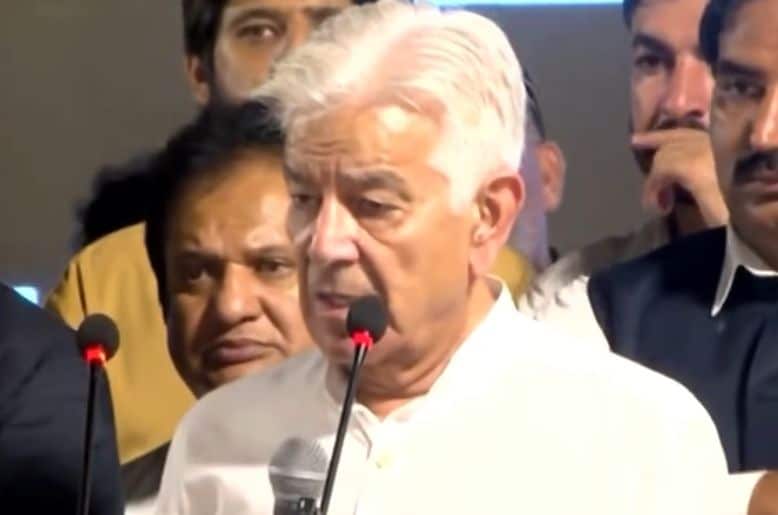
The Defence Minister of Pakistan, Khawaja Asif, has said that he continues to stand by his recent statement on Kashmir, while acknowledging differences between the Pakistan Muslim League-Nawaz (PML-N) and the Pakistan Peoples Party (PPP), which are coalition partners in the federal government.
While addressing the public in Sialkot, Khawaja Asif said that there were disagreements between the two parties on some issues, but there was no indication that the current government setup was about to collapse or undergo a major change.
Earlier, he commented about the people of Kashmir, saying, “Rawalakot is not Kashmir. I do not consider the people of Rawalakot to be proper Kashmiris because they speak Potohari. The same is the case with the people of Mirpur.”
He later defended his remarks, saying: “Kashmiriat is defined by the sacrifices and struggles waged over almost eight decades by Pakistanis, including Kashmiris and all others, not by birth certificates.”
He said that maintaining political continuity was in Pakistan’s interest, arguing that the country needed stability under the current circumstances.
Khawaja Asif also backed a recent statement by the head of the military’s media wing, the Inter-Services Public Relations (ISPR), but said there was a clear difference between the remarks made by Interior Minister Mohsin Naqvi and those of the ISPR director general.
He said Mr Naqvi’s comments also had a political dimension because the interior minister had been part of the current political system for several years.
While addressing the political state of Pakistan, the Defence Minister said he believed the continuation of the current “hybrid system” was the better option for the country, provided state institutions and the elected government operated within their constitutional responsibilities.
The defence minister also acknowledged his own role in successive governments, saying politicians should accept responsibility not only for their achievements but also for their shortcomings.
He also said state institutions should not be collectively blamed for past political decisions. However, he argued that individuals should be criticised if they made wrong decisions or misused their authority, regardless of whether they were politicians or members of the establishment.
On relations with the PPP, Mr Asif said disagreements were normal in coalition politics and could be resolved through dialogue.
He rejected suggestions that the differences between the two parties indicated the end of the current government, saying there was currently no sign of a major political change.
Read more: Mehwish Hayat set for drama industry comeback
Also read: Ministry of Defence announces more than 600 vacancies: complete guide step-by-step
