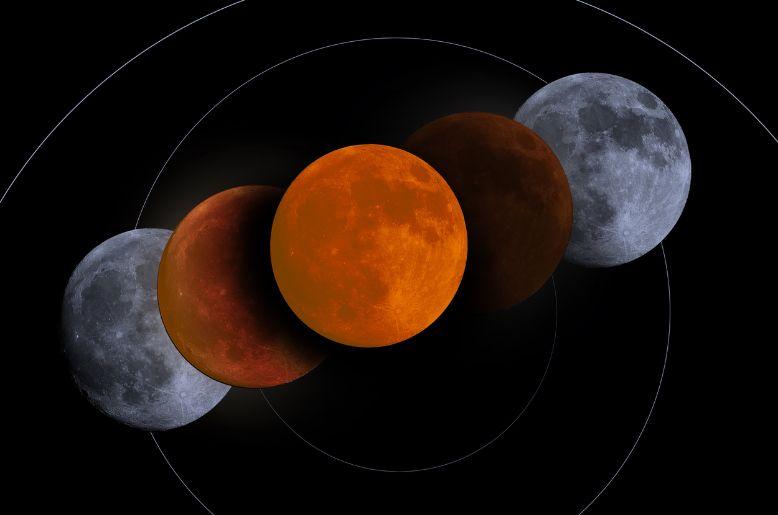
The Lunar eclipse 2026 in Pakistan will be one of the most spectacular astronomical events of the year. It occurs when the Moon moves into the Earth’s shadow, creating a darkened and reddish appearance known as a total lunar eclipse. This event will take place at the Moon’s descending node on March 3, 2026, with an umbral magnitude of 1.1507.
Lunar eclipses are safe to view with the naked eye, making them accessible to everyone. This article provides a complete guide on the eclipse’s date, timings, phases, visibility across Pakistan, and tips to enjoy the event fully.
What is a lunar eclipse
A lunar eclipse happens when the Earth comes between the Sun and the Moon. The Earth’s shadow blocks sunlight from reaching the Moon, causing it to darken. In a total lunar eclipse, the entire Moon enters the Earth’s umbra, giving it a red or coppery glow. Partial eclipses occur when only a part of the Moon passes through the Earth’s shadow.
The reddish color is caused by sunlight scattered through the Earth’s atmosphere. Dust and clouds can slightly change the hue. Lunar eclipses are different from solar eclipses because they are safe to watch directly.
Lunar eclipse 2026 in Pakistan date and time
The upcoming eclipse will be visible on Tuesday, March 3, 2026. The exact times for different phases of the eclipse in Pakistan are:
| Phase | Time (Pakistan Standard Time) |
| Penumbral Eclipse Begins | 7:11 PM |
| Partial Eclipse Begins | 8:23 PM |
| Total Eclipse Begins | 9:42 PM |
| Maximum Eclipse | 10:11 PM |
| Total Eclipse Ends | 10:40 PM |
| Partial Eclipse Ends | 11:58 PM |
| Penumbral Eclipse Ends | 1:10 AM (March 4) |
This table shows that viewers in Pakistan can see the eclipse for several hours, with totality lasting almost one hour.
Visibility across Pakistan
The eclipse will be visible across all major cities in Pakistan, including Karachi, Lahore, Islamabad, Peshawar, and Quetta. Clear skies will enhance visibility, while cloud cover may affect observation in some areas.
Unlike solar eclipses, lunar eclipses are not restricted to specific locations. People can watch the Moon rise in the east during totality and follow it across the night sky.
Phases of the eclipse
The Lunar eclipse 2026 in Pakistan has several distinct phases:
- Penumbral Phase: The Moon enters the faint outer shadow of the Earth, causing a subtle shading.
- Partial Phase: Part of the Moon moves into the dark umbra, and the shadow becomes visible.
- Total Phase: The entire Moon enters the Earth’s umbra and turns reddish. This is the most visually striking phase.
- Maximum Eclipse: The Moon is deepest in the Earth’s shadow.
- Ending Phases: The eclipse gradually reverses as the Moon exits the umbra and penumbra.
Each phase provides a unique view, and enthusiasts often photograph the Moon during totality to capture its red glow.
How to observe safely
Observing a lunar eclipse is safe without special equipment. However, binoculars or a small telescope can provide detailed views of the Moon’s surface. For photography, use a tripod and long exposure to capture the Moon’s red color and movement across the sky.
Check the weather forecast before the event to avoid cloudy nights. Observing open areas away from city lights will improve visibility and clarity.
Importance of lunar eclipses
Lunar eclipses are not only visually spectacular but also scientifically significant. They help astronomers study the Earth’s atmosphere by analyzing how it scatters sunlight onto the Moon. Historical records of lunar eclipses are used to calculate precise astronomical and calendar events.
For many cultures, lunar eclipses hold cultural and spiritual significance, symbolizing change and celestial alignment.
Predictions and analysis
The Lunar eclipse 2026 in Pakistan is predicted to be long-lasting and easily visible. Its umbral magnitude of 1.1507 ensures that the Moon will be fully covered by the Earth’s shadow. Unlike partial eclipses, this total lunar eclipse is expected to provide a vivid red color during maximum eclipse, making it ideal for skywatchers and photographers.
Eclipses like this help amateur astronomers learn more about orbital mechanics, shadow movement, and the relationship between the Earth, Moon, and Sun. Many people are asking if today’s ‘Blood Moon’ is really linked to the Iran–Israel war and what the connection might be between celestial events and regional conflict. Read our detailed article on Is today’s ‘Blood Moon’ really linked to the Iran–Israel war? To understand the facts and myths behind these claims.
Tips for best viewing
- Find an open area with a clear eastern horizon.
- Use binoculars or a telescope for enhanced viewing.
- Set up a tripod for photography to avoid blurred images.
- Start observing from the penumbral phase to watch the entire progression.
- Invite friends and family to enjoy the event safely.
Frequently asked questions
1. What is the date of the lunar eclipse 2026 in Pakistan?
The lunar eclipse will occur on Tuesday, March 3, 2026.
2. Is it safe to watch the lunar eclipse?
Yes, unlike solar eclipses, lunar eclipses are completely safe to view with the naked eye.
3. How long will the total lunar eclipse last?
Totality will last approximately 58 minutes, from 9:42 PM to 10:40 PM Pakistan time.
4. Can the lunar eclipse be seen in all cities of Pakistan?
Yes, the eclipse will be visible across Pakistan, including Karachi, Lahore, Islamabad, Peshawar, and Quetta.
5. Do I need special equipment to see the lunar eclipse?
No, the eclipse can be observed with the naked eye. Binoculars or telescopes can enhance details.