
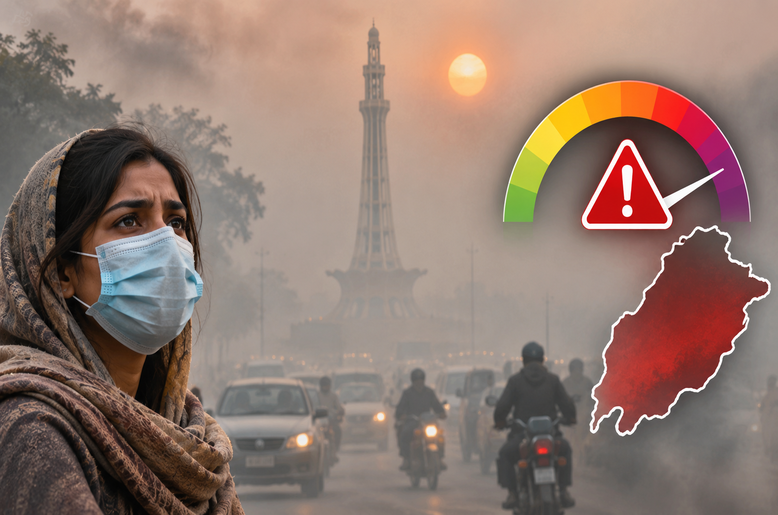
Air pollution has reached alarming levels across several cities in Punjab, with thick smog creating unhealthy conditions and making breathing difficult for residents.
Reportedly, Jhang recorded the highest Air Quality Index (AQI) at 678, followed by Multan at 658 and Gujranwala at 519.
Lahore recorded an AQI of 400, while Faisalabad reached 366.
An AQI above 300 is classified as hazardous under the US Environmental Protection Agency’s air quality scale. At this level, pollution can affect the entire population, including otherwise healthy individuals.
Fine particulate matter, particularly PM2.5, is a major concern during smog. These tiny particles can enter deep into the lungs and may reach the bloodstream, increasing the risk of respiratory and cardiovascular problems.
Punjab frequently experiences serious smog during the colder months, when weather conditions can trap pollutants near the ground.
Vehicle emissions, industrial activity, dust and agricultural burning are among the factors that contribute to poor air quality in the region.
Health experts advise precautionary measures
Medical experts have urged residents to avoid unnecessary travel and limit outdoor activities until air quality improves.
People are advised to wear well-fitting protective masks, preferably N95 or equivalent respirators, to reduce exposure to harmful airborne particles.
Children, older adults, pregnant women and people with asthma, heart disease or other respiratory conditions face greater risks from polluted air.
Residents are also advised to keep windows closed when outdoor pollution is severe and avoid strenuous exercise outside.
Indoor air purifiers with HEPA filters can help reduce exposure to fine particles.
Health experts recommend seeking medical attention if symptoms such as severe breathing difficulty, chest pain or persistent wheezing develop.
