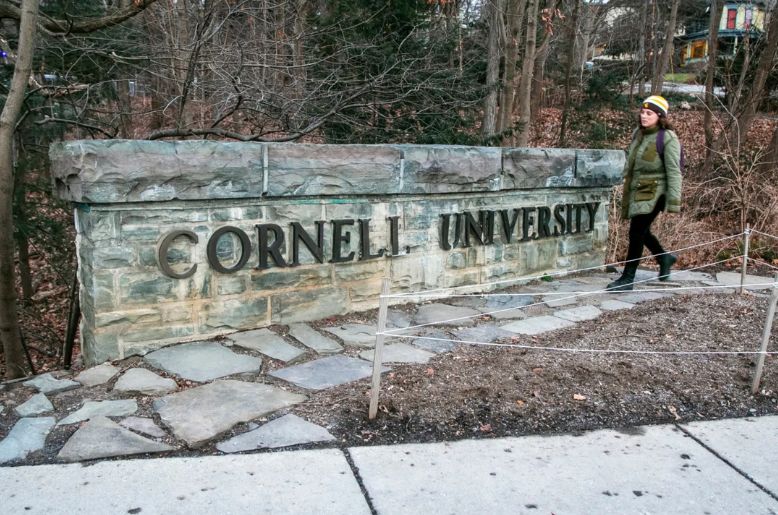
New York prosecutors have reopened a criminal investigation into allegations that a former Cornell University student was raped at a fraternity house in October 2024.
The woman, identified in court documents as Jane Doe, filed a civil lawsuit on September 16 against Cornell University, the Chi Phi fraternity and seven former fraternity members. She alleges that she was drugged and sexually assaulted by multiple men at the fraternity house.
Tompkins County District Attorney Matthew Van Houten said his office will present the case to a grand jury, which will consider whether criminal charges should be brought.
What does the lawsuit allege?
According to the lawsuit, Jane Doe was 20 when she visited the Chi Phi fraternity house on October 19, 2024. She alleges that she had already consumed alcohol and was later given more alcohol and pressured into taking what she was told was ketamine.
The lawsuit alleges that she became incapable of consenting and was sexually assaulted by multiple fraternity members over several hours.
It also includes an alleged Snapchat group message in which one fraternity member appeared to alert others that a woman was upstairs and available for sex.
Jane Doe reported the incident to Cornell University Police on November 8, 2024, according to the lawsuit.
Why was the criminal case initially not prosecuted?
Van Houten said his office decided in November 2024 that the available evidence did not meet the legal threshold for criminal charges.
He said Jane Doe’s sworn statement at the time described her participation in drug use and sexual activity as voluntary and consensual and did not allege that she had been drugged against her will or gang-raped.
However, her attorney disputes the DA’s account of the initial investigation.
A transcript obtained by CBS News reportedly shows Jane Doe telling a Cornell police investigator that she was raped later during the night. Van Houten said he had not previously seen the full interview transcript and would obtain it as part of the reopened investigation.
What does Cornell say?
Cornell said it conducted a separate Title IX investigation into the allegations.
The university said a panel of trained faculty and staff reviewed evidence and imposed sanctions that included expulsions and suspensions.
Cornell also denied the allegation that the accused students were simply allowed to write essays as punishment.
The university suspended the Chi Phi chapter in 2024, and Cornell says the chapter remains barred from campus.
What do the accused students say?
Attorneys representing some of the former fraternity members have denied the allegations.
One attorney acknowledged that his client made an inappropriate Snapchat comment but said he did not sexually assault or touch Jane Doe.
Another defence attorney said his client “unequivocally denies” the allegations and argued that accusations in a civil lawsuit should not be treated as proof of criminal wrongdoing.
No criminal charges have been filed against the seven men at this stage.
What role could the Snapchat messages play?
The alleged Snapchat messages have become a significant part of the public discussion surrounding the case.
Van Houten described the messages as vulgar but said their relevance to the question of consent would be considered by the grand jury.
Cornell has confirmed that its police department provided a Snapchat screenshot to the DA’s office in 2024.
Additional text messages reportedly exchanged between Jane Doe and one of the defendants two days after the alleged incident have also emerged. Her attorney says she was traumatised and trying to understand what had happened when the messages were sent.
What happens next?
The district attorney has said the reopened investigation will consider Jane Doe’s account, the evidence from the civil lawsuit and any additional evidence that emerges.
The case is expected to go before a Tompkins County grand jury, which will determine whether there is sufficient evidence to issue criminal charges.
A separate civil case against Cornell and the other defendants is also continuing, with an initial hearing scheduled for October 23 in Manhattan.
Why has the case attracted wider attention?
The case has prompted renewed debate over how universities and law enforcement handle allegations of sexual assault, particularly when alcohol or drugs are involved.
It has also renewed discussion in New York over laws concerning sexual activity involving people who are incapacitated after voluntarily consuming alcohol or drugs.
New York lawmakers and sexual-assault advocates have previously pushed for changes to the state’s law, arguing that a person’s voluntary intoxication should not prevent legal protection when they become incapable of consenting. Supporters and opponents of changes to the law have offered different interpretations of how such cases should be handled.
The case has also drawn public comments from figures including US Rep. Alexandria Ocasio-Cortez and actor Florence Pugh, while Ithaca Mayor Robert Cantelmo has called for changes to Cornell’s protocols concerning sexual violence and student gatherings.
