
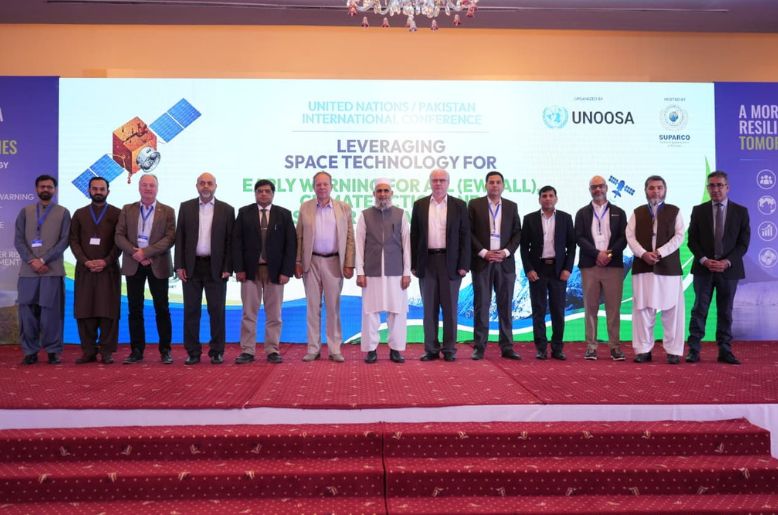
The fourth day of the UN/Pakistan International Conference on “Leveraging Space Technology for EW4All, Climate Action and Disaster Risk Assessment,” hosted by SUPARCO, focused on “Innovation, Youth & Field Experience.”
It brought together national and international experts, researchers, academics and young professionals to explore innovative applications of space technology, GeoAI and emerging technologies for climate resilience and disaster risk reduction.
The day’s proceedings featured two technical sessions, highlighting advancements in geospatial technologies, artificial intelligence and youth-led climate research.
What was the first session about?
The first session, “Innovative Tools and GeoAI,” explored the role of UN-SPIDER in the UN Early Warning for All initiative, and the responsible and ethical applications of GeoAI for disaster risk reduction. It also explored the potential of geospatial technologies for socio-economic transformation.
Presentations also showcased AI-driven multi-hazard risk assessment, climate-related health analysis, agentic AI for proactive early warning, satellite-based earthquake precursor research and innovative tools for building damage assessment.
What was the second session about?
The second session, “Rising Voices: Youth-Led Climate Research and Action,” provided a platform for emerging researchers and young professionals to present innovative research addressing critical climate and disaster-related challenges.
Topics included satellite-based landslide assessment, GeoAI applications, snow-cover changes and GLOF risks in the Hunza Basin, streamflow prediction in data-scarce regions, AI-driven flood management, climate-resilient settlement recovery, urban subsidence monitoring, decentralised early warning systems, climate variability and above-ground biomass estimation using LiDAR and machine learning.
The session highlighted the growing contribution of academic institutions and young researchers to developing practical, technology-driven solutions for climate resilience.
Panel discussion
A panel discussion on “Paris Climate Change Agreement – How Space Can Help in Its Realisation” brought together experts from Pakistan and China to deliberate on the role of satellite-based observations, geospatial intelligence and space-enabled technologies in supporting climate commitments, environmental monitoring, informed policymaking and sustainable development.
The discussion featured representatives from the Ministry of Climate Change and Environmental Coordination, SUPARCO, China’s Aerospace Information Research Institute, Global Change Impact Studies Centre and NUST, with the session moderated by the Sustainable Development Policy Institute (SDPI).
As part of the day’s field engagement, conference participants also undertook a technical visit to the National Disaster Management Authority (NDMA) to gain insights into institutional mechanisms, operational capabilities and the application of technology in disaster preparedness, response and risk management.

